

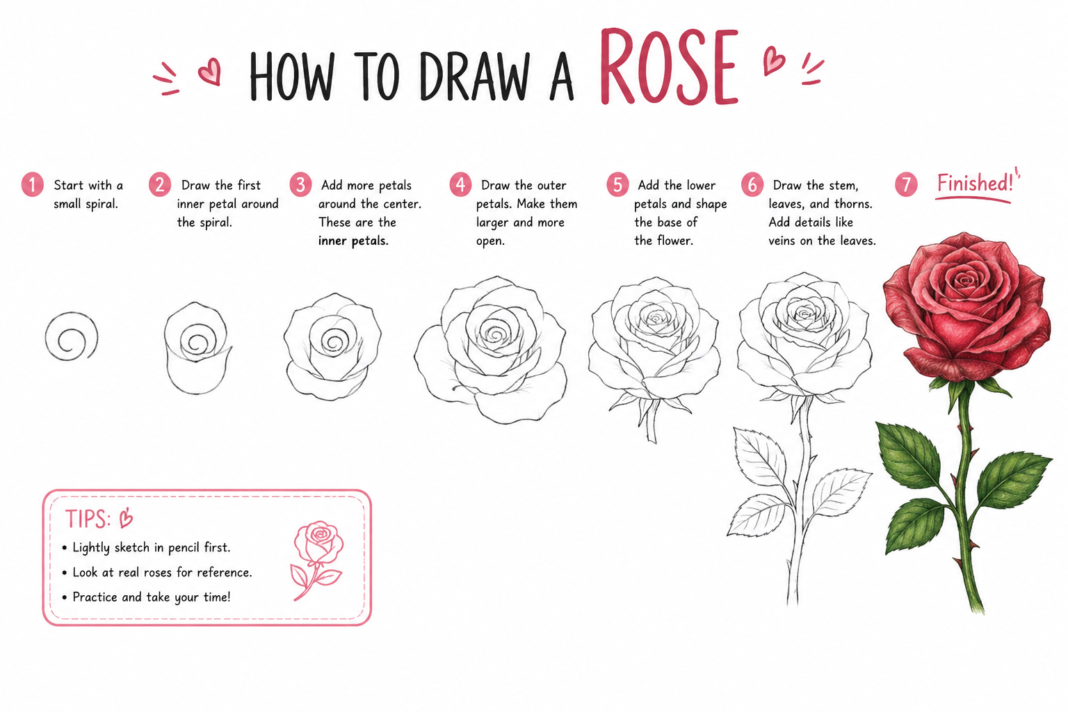

Roses have inspired artists for centuries because they combine elegance, softness, movement, and intricate detail in one natural form. Whether you are sketching casually in a notebook or building professional illustration skills, learning how to draw a flower rose can dramatically improve your understanding of shape, texture, and shading.
Many beginners assume roses are difficult because of their layered petals and complex curves. In reality, once you understand the structure behind the bloom, the process becomes surprisingly approachable. This guide breaks everything down into clear, practical techniques that help artists at every level create realistic, stylized, or decorative rose drawings with confidence.
Why Roses Are One of the Best Subjects for Artists
Roses are ideal drawing subjects because they teach multiple artistic fundamentals at once. When practicing how to draw a flower rose, you learn symmetry, petal layering, light direction, texture rendering, and natural composition in a single exercise.
Another reason roses remain popular is their flexibility in artistic style. A rose can look beautiful as a quick cartoon sketch, a detailed graphite study, watercolor artwork, tattoo design, or digital illustration. This versatility allows artists to revisit the same subject repeatedly while developing new techniques over time.
Understanding the Basic Structure of a Rose
Before starting detailed sketch work, it helps to understand the anatomy of a rose. Most roses begin with a tightly folded center that gradually opens into larger outer petals, creating a spiral-like structure that expands outward naturally.
When people struggle with how to draw a flower rose, the issue is usually focusing on individual petals too early. Instead, artists should first see the rose as a collection of flowing shapes organized around a soft circular core. This broader perspective creates cleaner, more balanced sketches.
Essential Drawing Supplies for Rose Sketching
You do not need expensive materials to create beautiful rose artwork. A basic pencil set, smooth paper, eraser, and blending tool are enough for beginners practicing how to draw a flower rose at home.
Artists who want more refined results may later explore mechanical pencils, charcoal, colored pencils, fineliners, or digital drawing tablets. However, strong observation skills matter far more than premium supplies during the learning stage.
Choosing the Right Pencil Grades
Different pencil grades affect line quality and shading depth. Hard pencils like H or 2H create lighter construction lines, while softer pencils such as 2B or 6B produce darker shadows and smoother blending.
Using multiple pencil grades helps create dimension in rose drawings. Artists learning how to draw a flower rose often improve quickly once they understand how contrast and tonal variation give petals realistic depth and softness.
The Importance of Light Construction Shapes
Professional artists rarely start with final outlines immediately. They begin with circles, spirals, and directional guidelines that establish the rose’s overall structure before adding details.
Construction shapes reduce mistakes because they simplify the flower into manageable forms. This method also prevents uneven petals and awkward proportions that commonly appear in beginner rose sketches.
How to Observe Real Roses Like an Artist
Observation is one of the most valuable artistic skills. Instead of seeing a rose as a “flower,” artists learn to notice curves, overlaps, shadows, folds, and transitions between light and dark areas.
When studying how to draw a flower rose, observing real references improves accuracy dramatically. Even a simple garden rose reveals subtle details in petal edges and natural asymmetry that photographs sometimes flatten.
Step-by-Step Breakdown of a Simple Rose Drawing
Start by sketching a small spiral in the center of the page. This spiral represents the tightly folded inner petals that form the heart of the rose.
Next, gradually add larger petals around the spiral using curved, organic lines. Avoid perfect symmetry because natural roses have slight irregularities that make them feel alive and realistic.
Building Realistic Petal Layers
Petal layering creates the signature fullness of a rose. Inner petals remain smaller and tighter, while outer petals open wider and curve outward with softer edges.
Artists practicing how to draw a flower rose should focus on overlap. Every petal should partially hide or connect to another petal, creating depth and natural flow throughout the bloom.
Common Mistakes Beginners Make
One of the biggest mistakes beginners make is outlining every petal too heavily. Thick outlines can flatten the drawing and remove the delicate softness that makes roses visually appealing.
Another common issue is drawing identical petals repeatedly. Real roses vary in shape, size, angle, and curvature, so adding subtle differences helps the flower appear far more realistic.
How Shading Creates Depth and Realism
Shading transforms a flat sketch into a dimensional flower. The areas where petals overlap naturally create shadows, while exposed petal edges catch more light.
When learning how to draw a flower rose, understanding shadow placement is more important than creating perfect outlines. Gentle tonal transitions give roses their soft, velvety appearance.
Techniques for Smooth Pencil Blending
Blending helps create soft gradients across petals and shadows. Artists often use tissue paper, blending stumps, cotton swabs, or even fingertips to smooth graphite transitions.
Overblending, however, can remove texture and detail. Effective rose drawings balance smooth shading with crisp edges that preserve the flower’s layered structure and visual clarity.
Drawing Rose Leaves and Stems Naturally
Rose leaves typically grow in clustered formations with pointed tips and serrated edges. Their directional growth patterns help create more believable botanical drawings.
The stem should not appear perfectly straight. Slight curves and natural variation make the flower feel organic, especially when paired with realistic thorns and branching leaf stems.
Comparing Different Rose Drawing Styles
| Style | Best For | Visual Characteristics | Skill Level |
| Cartoon Rose | Quick sketches and icons | Simplified petals and bold lines | Beginner |
| Realistic Rose | Fine art and portraits | Detailed shading and layered petals | Intermediate to advanced |
| Tattoo Rose | Design work | Strong outlines and dramatic contrast | Intermediate |
| Watercolor Rose | Soft artistic effects | Gentle gradients and fluid edges | Intermediate |
| Digital Rose | Modern illustration | Flexible editing and layered rendering | All levels |
| Botanical Rose | Scientific accuracy | Precise structure and anatomy | Advanced |
This comparison shows that artists can approach how to draw a flower rose in multiple ways depending on their creative goals. Exploring several styles helps improve artistic adaptability and confidence.
Why Negative Space Matters in Flower Drawing
Negative space refers to the empty areas surrounding petals and stems. Many artists focus only on the object itself, but surrounding shapes are equally important for accuracy.
By observing negative space carefully, artists avoid distorted petal spacing and awkward proportions. This technique improves balance and creates more visually pleasing compositions.
Creating Dynamic Rose Compositions
A single centered rose can look elegant, but more dynamic compositions often include angled stems, overlapping flowers, or partially opened buds.
Artists studying how to draw a flower rose can create stronger artwork by experimenting with perspective and arrangement. Even slight tilts or cropped framing choices add visual energy.
How Perspective Changes Rose Drawings
A rose viewed from above appears dramatically different from one viewed from the side. Top-down perspectives emphasize spiral petal arrangements, while side views highlight depth and layered structure.
Practicing multiple angles trains the eye to understand three-dimensional form. This skill becomes essential for artists moving into advanced floral illustration or design work.
Using References Without Copying
Reference images help artists understand lighting, anatomy, and structure, but blindly tracing references limits artistic growth. Effective practice involves observing and interpreting rather than duplicating mechanically.
A useful approach is studying several rose references simultaneously. This encourages artists to understand underlying patterns while developing their own visual style and creative interpretation.
The Role of Gesture in Floral Drawing
Gesture drawing is often associated with figure drawing, but it also applies beautifully to flowers. Roses contain natural movement through their curling petals and bending stems.
Capturing this movement adds life and elegance to the artwork. Even simple rose sketches become more expressive when artists prioritize flow instead of rigid precision.
Improving Line Quality for Better Results
Confident lines make rose drawings appear cleaner and more professional. Short, scratchy marks can create visual clutter and make petals look uncertain or stiff.
Artists improving how to draw a flower rose should practice long, controlled strokes that follow the natural direction of petal curves. Line confidence improves steadily through repetition and patience.
Realistic Texture Techniques for Rose Petals
Rose petals have a soft, almost velvety texture that can be suggested through subtle shading and gentle tonal shifts. Sharp contrasts should remain limited to deeper shadow areas.
Texture becomes more convincing when artists vary pressure lightly across the page. Tiny tonal changes often create more realism than excessive detail or harsh outlines.
How Digital Artists Draw Roses
Digital artists use many of the same foundational principles as traditional artists. Construction lines, layering, lighting, and composition remain essential regardless of medium.
The advantage of digital tools lies in flexibility. Layers, undo functions, and customizable brushes make experimenting with how to draw a flower rose more accessible for modern creators.
Coloring Techniques for Rose Artwork
Red roses are iconic, but roses exist in countless shades including pink, yellow, white, orange, lavender, and deep burgundy. Color variation adds emotion and personality to floral illustrations.
Successful coloring relies on value relationships rather than color alone. Even vibrant roses require balanced shadows and highlights to maintain believable depth and realism.
How Artists Use Roses Symbolically
Roses symbolize love, beauty, passion, remembrance, and transformation across many cultures. Their emotional associations make them common subjects in tattoos, fine art, greeting cards, and branding.
Understanding symbolism can influence artistic decisions. A softly shaded rose may feel romantic and nostalgic, while bold high-contrast roses can appear dramatic and powerful.
Practicing Rose Drawing Efficiently
Improvement comes from consistency rather than marathon sessions. Short daily sketching exercises often produce better long-term progress than infrequent intensive drawing sessions.
Artists learning how to draw a flower rose should practice multiple quick studies instead of obsessing over a single perfect drawing. Repetition strengthens observation, muscle memory, and confidence.
The Value of Studying Master Artists
Many famous artists incorporated roses and floral studies into their work. Studying historical botanical illustrations and contemporary floral art provides valuable insight into composition and technique.
Observing professional work teaches subtle artistic decisions that beginners may overlook. Lighting choices, edge control, and petal simplification all become clearer through careful analysis.
Drawing Closed Rosebuds and Blooming Roses
Closed rosebuds emphasize tapered forms and tightly wrapped petals, while fully opened roses reveal expansive layered structures and dramatic shadow patterns.
Practicing both stages improves versatility and deepens understanding of floral anatomy. Artists who study multiple growth phases develop stronger observational and compositional skills overall.
Using Ink for Bold Rose Illustrations
Ink drawings create dramatic contrast and strong visual impact. Artists often combine fine hatching, stippling, or brush pen techniques to create texture and dimension.
Unlike pencil, ink requires greater commitment because corrections are limited. This encourages artists to plan carefully and develop more deliberate line control.
How Backgrounds Affect Floral Artwork
Background choices dramatically influence the mood of a rose drawing. Minimal backgrounds emphasize elegance, while textured or atmospheric settings create narrative depth.
Artists practicing how to draw a flower rose sometimes overlook composition beyond the flower itself. However, thoughtful backgrounds can transform a simple sketch into a complete artwork.
Combining Roses With Other Design Elements
Roses pair beautifully with ribbons, clocks, butterflies, geometric shapes, or handwritten typography. These combinations appear frequently in tattoo art, branding, and decorative illustration.
Mixed compositions also help artists develop storytelling skills. Adding supporting elements creates emotional context and expands creative possibilities beyond standalone floral studies.
The Psychology of Floral Art
Floral artwork often evokes calmness and emotional connection because humans naturally respond to organic forms and balanced patterns found in nature.
This emotional resonance explains why rose imagery remains consistently popular across art, fashion, interior design, and digital media. Drawing flowers can even become a relaxing mindfulness practice for many artists.
Overcoming Frustration During Practice
Every artist experiences awkward sketches and failed attempts. Improvement rarely happens in a perfectly smooth progression, especially with complex organic subjects like roses.
A helpful mindset is focusing on progress rather than perfection. Each sketch teaches something valuable about structure, shading, or observation, even when the result feels imperfect.
Advanced Techniques for Hyperrealistic Roses
Hyperrealistic rose drawings require close attention to micro-details such as reflected light, petal translucency, and subtle texture variation. Artists often work in layers over many hours.
These advanced techniques become manageable only after mastering fundamentals. Strong structure and shading skills remain the foundation of every successful realistic floral drawing.
The Importance of Patience in Artistic Growth
Learning to draw well takes time because artistic skill combines observation, hand coordination, memory, and visual interpretation simultaneously.
As artist Vincent van Gogh once said, “Great things are done by a series of small things brought together.” That idea perfectly reflects the process of mastering how to draw a flower rose through steady, consistent practice.
How Social Media Changed Floral Art Trends
Platforms like Instagram, Pinterest, and TikTok have expanded interest in floral illustration dramatically. Artists now share tutorials, process videos, and stylized rose artwork with global audiences instantly.
This accessibility benefits beginners because learning resources are more available than ever. Artists can study countless interpretations of roses across traditional, digital, and mixed-media styles.
Why Simplicity Often Creates Stronger Art
Beginners sometimes assume more detail automatically means better quality. In reality, strong composition and clean structure usually matter more than excessive rendering.
Simple rose drawings can feel elegant and expressive when artists focus on confident shapes, balanced shading, and thoughtful design rather than overwhelming detail.
Conclusion
Mastering how to draw a flower rose is not about memorizing a single perfect formula. It is about understanding structure, observing natural forms carefully, and practicing consistently with patience and curiosity. Roses may appear complex initially, but breaking them into simple shapes and layered petals makes the process approachable for artists at every level.
Whether your goal is realistic botanical art, expressive sketching, tattoo design, digital illustration, or casual creative practice, rose drawing develops foundational artistic skills that apply across countless subjects. The more you observe, experiment, and refine your techniques, the more naturally beautiful your rose drawings will become.
FAQ
How long does it take to learn how to draw a flower rose?
Most beginners can learn the basic structure within a few days of practice. Developing realistic shading and advanced detail usually takes several weeks or months of consistent sketching.
What is the easiest way to start drawing a rose?
The easiest method is beginning with a spiral center and gradually adding larger petals outward. This approach simplifies how to draw a flower rose into manageable stages.
Which pencils are best for rose drawings?
HB pencils work well for sketching, while softer pencils like 2B or 4B help create darker shadows and smoother shading for realistic petal depth.
Can beginners learn how to draw a flower rose without art classes?
Yes, many artists develop strong floral drawing skills through self-study, observation, tutorials, and regular practice without formal training.
Why do my rose drawings look flat?
Flat drawings usually result from limited shading or weak contrast. Adding deeper shadows where petals overlap creates stronger depth and dimension.
Is tracing helpful when learning rose drawing?
Tracing can help beginners understand shapes initially, but relying on observation and freehand practice builds stronger long-term drawing skills.
How can I make my rose drawings more realistic?
Focus on layered petals, soft shading transitions, varied line weight, and careful observation of real flowers or quality references.
What style is best for beginners practicing roses?
Simple sketch or cartoon styles are often best at first because they help artists understand structure before moving into highly detailed realism.
You May Also Read: Flower Pic Drawing