

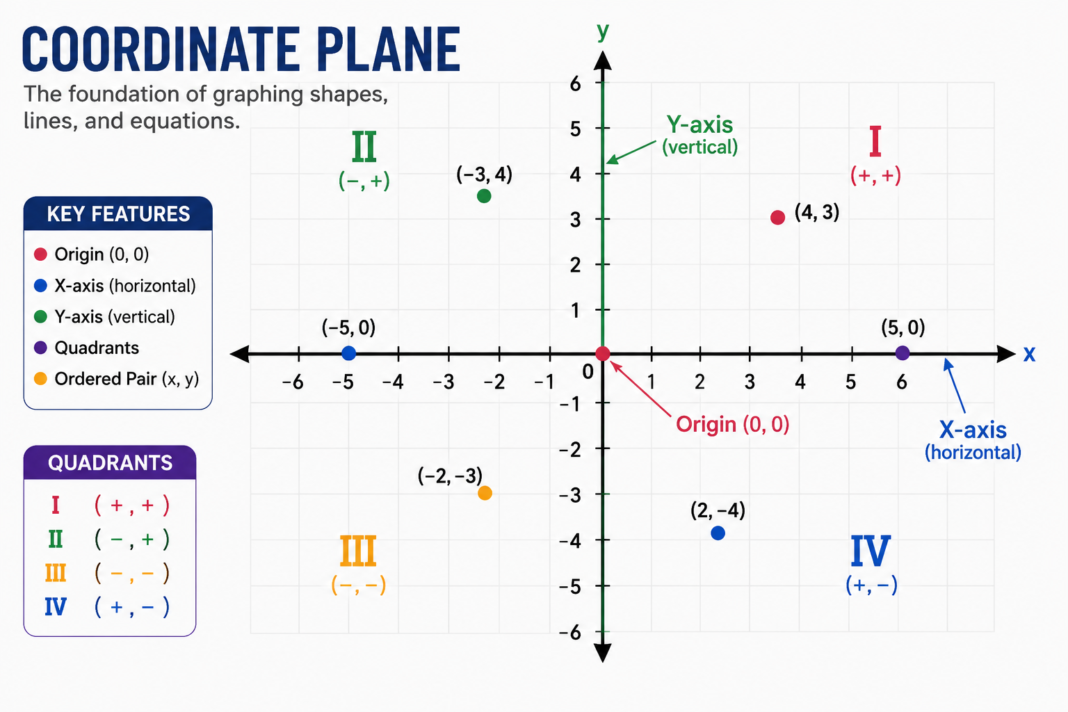

The coordinate plane is one of the most important concepts in mathematics because it transforms numbers into visual information. Whether you’re plotting a point, graphing a line, analyzing data, or solving algebraic equations, understanding this system creates a strong foundation for advanced math and real-world problem-solving.
Students first encounter the coordinate system in middle school, but its importance extends far beyond the classroom. Engineers, architects, programmers, scientists, economists, pilots, and designers all rely on coordinate-based systems to organize location, movement, and relationships between variables. Once you understand how a coordinate plane works, many mathematical ideas become easier to visualize and solve.
Understanding the Coordinate Plane
A coordinate plane is a flat, two-dimensional surface formed by two number lines that intersect at a right angle. The horizontal line is called the x-axis, while the vertical line is called the y-axis. Their intersection creates the origin, represented by (0,0), which serves as the starting point for measuring every location on the graph. The system provides an organized method for identifying exact positions using Cartesian coordinates and ordered pairs.
Every point on the graph is written as an ordered pair, where the first number represents the horizontal movement and the second number indicates the vertical movement. Moving right means positive x-values, while moving left means negative x-values. Similarly, moving upward produces positive y-values, and moving downward results in negative y-values. Understanding graphing points and axis directions helps eliminate confusion when reading or creating graphs.
History and Development of the Coordinate System
The mathematical framework behind the coordinate plane is credited to the French mathematician René Descartes during the seventeenth century. His revolutionary idea connected algebra with geometry, allowing equations to be represented visually instead of existing only as numerical expressions. This innovation laid the foundation for modern analytic geometry and mathematical visualization.
Descartes’ work transformed mathematics by enabling researchers to solve geometric problems through algebraic methods. Today, this same concept powers everything from engineering software to GPS navigation. The combination of geometric representation and algebraic relationships remains one of the most influential developments in mathematical history.
Parts of a Coordinate Plane
Several essential components work together to create a complete coordinate plane. These include the x-axis, y-axis, origin, quadrants, scale, grid lines, and plotted points. Each element contributes to accurately locating positions and interpreting mathematical relationships through coordinate geometry and graph interpretation.
Understanding how these components interact allows students to analyze graphs with confidence. For example, selecting an appropriate scale ensures accuracy, while recognizing the origin helps establish direction. Mastering graph structure and mathematical coordinates makes more advanced topics significantly easier to understand.
| Component | Purpose | Example |
| X-axis | Horizontal measurement | (5,3) moves 5 units right |
| Y-axis | Vertical measurement | (5,3) moves 3 units up |
| Origin | Starting point | (0,0) |
| Quadrants | Divide the graph into four regions | Quadrant I contains (+,+) |
| Ordered Pair | Identifies exact location | (2,-4) |
| Scale | Determines measurement intervals | Every square equals 1 unit |
| Grid Lines | Improve plotting accuracy | Equal spacing across graph |
The Four Quadrants Explained
The x-axis and y-axis divide the coordinate plane into four separate regions known as quadrants. Quadrant I contains positive x-values and positive y-values, while Quadrant II contains negative x-values and positive y-values. Quadrant III includes negative values for both axes, and Quadrant IV contains positive x-values with negative y-values. Understanding positive coordinates and negative coordinates simplifies graph reading.
Recognizing quadrant patterns makes plotting much faster because the signs immediately indicate the correct region. Instead of guessing locations, students can identify the destination by examining the signs of each ordered pair. Building confidence with quadrant identification and graph locations supports success in algebra and geometry.
How to Plot Points Correctly
Plotting a point begins by locating the x-coordinate and moving horizontally from the origin. After reaching the correct horizontal position, move vertically according to the y-coordinate until arriving at the final location. This straightforward process relies on understanding horizontal movement and vertical movement within the graph.
For example, consider the point (4,-3). Start at the origin, move four units to the right, and then move three units downward. Marking this location accurately demonstrates the relationship between ordered pairs and graph positions. Practicing point plotting and coordinate accuracy helps reduce common mistakes.
Reading Coordinates from a Graph
Reading coordinates follows the opposite process of plotting. First identify the horizontal position relative to the y-axis, then determine the vertical position relative to the x-axis. Always write the x-coordinate first and the y-coordinate second when recording graph coordinates and location values.
Many beginners accidentally reverse the coordinate order, leading to incorrect answers. Remember that ordered pairs always follow the format (x,y). Developing consistency with coordinate notation and graph reading improves mathematical accuracy across every topic involving graphs.
Coordinate Plane and Linear Equations
Linear equations become far more meaningful when represented visually on the coordinate plane. Instead of interpreting numbers alone, students can observe how changing variables affects the direction and steepness of a line. This visual perspective strengthens understanding of linear functions and graphing equations.
Slope, intercepts, and rate of change become easier to analyze through graphs. A positive slope rises from left to right, while a negative slope falls across the graph. Learning slope analysis and line graphs provides a foundation for algebra, calculus, and statistics.
“Mathematics becomes easier to understand when abstract ideas are transformed into visual patterns.”
Graphing Lines and Functions
Every function can generate a collection of points that create a recognizable pattern on the coordinate plane. Straight lines represent linear functions, while curves often represent quadratic, exponential, or trigonometric relationships. Observing function graphs and mathematical relationships helps students identify patterns quickly.
Graphing functions also reveals valuable information such as maximum values, minimum values, intercepts, and symmetry. Instead of memorizing formulas alone, students gain visual intuition by studying graph behavior and function analysis.
Distance and Midpoint on the Coordinate Plane
The coordinate plane makes measuring distances between two points possible using the distance formula. Rather than estimating visually, mathematicians calculate exact lengths based on coordinate differences. Understanding distance formula and point relationships is valuable in geometry and engineering.
Similarly, the midpoint formula determines the exact center between two locations by averaging the x-values and y-values separately. These concepts appear frequently in mathematics, computer graphics, and navigation because they simplify geometric calculations and spatial reasoning.
Real-World Applications of the Coordinate Plane
The coordinate plane extends far beyond textbooks into countless professional fields. GPS navigation systems continuously calculate locations using coordinate-based models, while architects design buildings through digital coordinate systems. Professionals rely on location mapping and spatial analysis to achieve precision.
Video game developers, data analysts, meteorologists, economists, and robotics engineers all depend on coordinate systems. Every moving object within a digital environment occupies a specific coordinate position. Understanding computer graphics and data visualization demonstrates why coordinate geometry remains highly relevant today.
Common Mistakes Students Make
Many students struggle because they confuse x-values with y-values or reverse the order of ordered pairs. Others overlook negative signs, causing plotted points to appear in incorrect quadrants. Careful attention to coordinate order and sign conventions prevents these frequent errors.
Another common issue involves inconsistent graph scales. Unequal spacing can distort graphs and produce misleading conclusions. Developing habits of checking graph accuracy and consistent scaling improves confidence while solving mathematical problems.
Tips for Mastering Coordinate Plane Skills
Regular practice remains the most effective strategy for mastering the coordinate plane. Plotting several points each day gradually builds familiarity with quadrants, axes, and graph interpretation. Short, focused sessions emphasizing visual learning and graph practice often produce better long-term retention than lengthy study sessions.
Students should also connect graphing activities to everyday experiences whenever possible. Mapping locations, interpreting charts, and exploring digital maps reinforce mathematical understanding outside the classroom. Combining problem-solving skills with real-world examples makes learning both meaningful and enjoyable.
Why the Coordinate Plane Matters in Modern Education
Modern education emphasizes critical thinking, visualization, and analytical reasoning rather than memorization alone. The coordinate plane supports these goals by helping learners transform equations into meaningful graphical representations. This strengthens both mathematical thinking and analytical skills across multiple disciplines.
As technology becomes increasingly data-driven, coordinate systems appear in programming, artificial intelligence, machine learning, and scientific research. Building a strong understanding of digital mapping and data interpretation prepares students for future academic and professional opportunities.
Conclusion
The coordinate plane serves as one of mathematics’ most powerful visual tools because it connects numbers, equations, and geometry into a single organized system. From plotting simple points to analyzing advanced mathematical functions, it enables learners to understand relationships with greater clarity and confidence.
Whether you are a beginner learning ordered pairs or an advanced student exploring calculus, mastering coordinate geometry creates lasting mathematical skills. Through consistent practice, careful observation, and real-world application, the coordinate plane becomes far more than a classroom concept—it becomes a universal language for describing position, movement, and mathematical relationships.
Frequently Asked Questions
What is a coordinate plane?
A coordinate plane is a two-dimensional graph formed by the x-axis and y-axis, allowing points to be identified using ordered pairs. It is widely used in coordinate geometry and graphing points.
Why is the coordinate plane important?
The coordinate plane helps visualize equations, analyze data, solve geometry problems, and represent mathematical relationships clearly. It also supports graph interpretation and spatial reasoning.
What are the four quadrants on a coordinate plane?
The four quadrants divide the graph according to positive and negative x- and y-values. Understanding the quadrant system and axis directions makes plotting much easier.
How do you plot a point on a coordinate plane?
Start at the origin, move horizontally according to the x-coordinate, then vertically according to the y-coordinate. Following this method improves point plotting and coordinate accuracy.
Where is the coordinate plane used in real life?
The coordinate plane appears in GPS navigation, engineering, architecture, programming, gaming, economics, robotics, and scientific research. These fields rely heavily on location mapping and computer graphics.
What is the origin on a coordinate plane?
The origin is the point where the x-axis and y-axis intersect, written as (0,0). It acts as the reference point for Cartesian coordinates and graph positioning.