

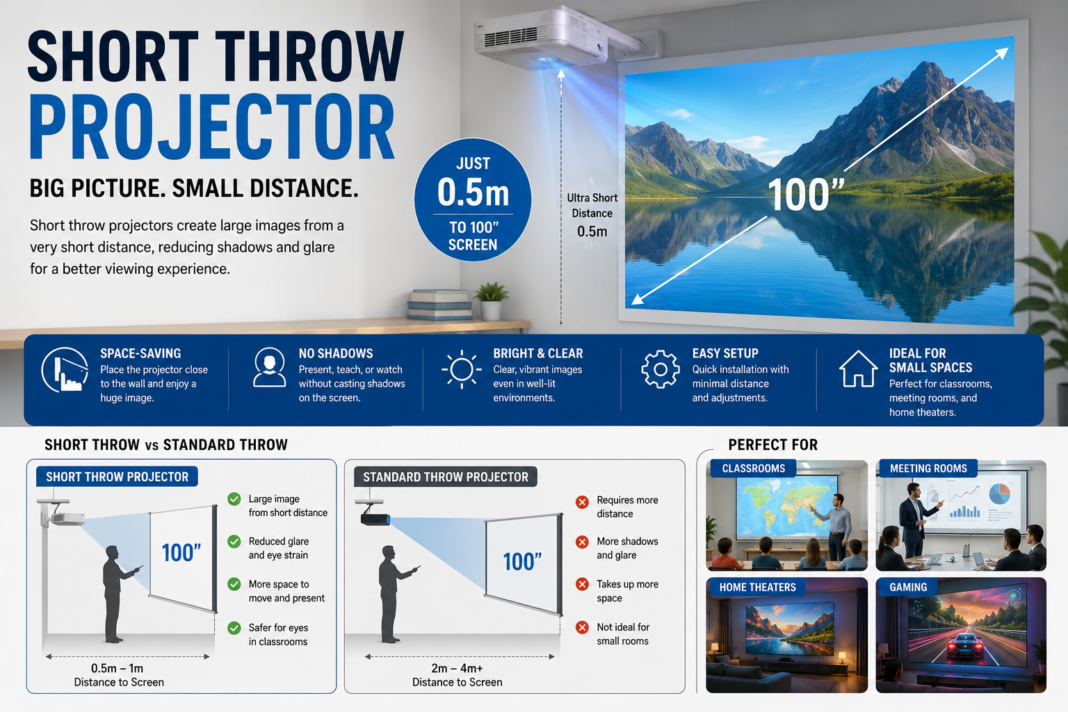

A Short Throw Projector can transform almost any room into a cinematic entertainment space, professional presentation environment, or immersive gaming setup. Yet many people struggle with limited room dimensions, awkward furniture placement, and the challenge of mounting equipment far from the screen. That is where a short throw projector becomes one of the most practical display technologies available today.
Unlike traditional projectors that require significant distance between the projector and the screen, modern short-throw models can create large images from surprisingly close positions. This capability has made them increasingly popular among homeowners, gamers, educators, business professionals, and anyone looking to maximize screen size without sacrificing valuable room space.
This comprehensive guide explores everything you need to know about choosing, installing, and optimizing a short throw projector. Whether you are building a home theater, upgrading a conference room, or creating a gaming station, this resource provides the depth and practical insight needed to make an informed decision.
Understanding What a Short Throw Projector Is
A short throw projector is designed to produce a large image while positioned much closer to the projection surface than a conventional projector. The defining characteristic is its throw ratio, which measures the relationship between the distance from the projector to the screen and the resulting image width.
Traditional projectors often require eight to fifteen feet of distance to generate a large image. By contrast, a short throw projector can often create a 100-inch display from just a few feet away. This dramatically changes room planning possibilities and makes projector ownership practical for smaller spaces.
How Throw Ratio Determines Performance
Throw ratio is one of the most important specifications when evaluating projection equipment. It is calculated by dividing the distance from the lens to the screen by the width of the projected image.
For example, a projector with a 0.5:1 throw ratio can produce a 100-inch-wide image from approximately 50 inches away. Lower throw ratios generally indicate greater flexibility in compact environments and help users achieve large-screen experiences without requiring deep rooms.
Why Short Throw Technology Has Become So Popular
Consumer preferences have shifted toward larger displays and more immersive viewing experiences. At the same time, many people live and work in spaces where traditional projector placement is difficult or impossible.
The growing popularity of the short throw projector stems from its ability to solve these challenges. Users can enjoy massive screen sizes while maintaining comfortable room layouts, reducing installation complexity, and minimizing visual distractions created by projector placement.
The Evolution of Projection Systems
Projector technology has evolved dramatically over the past two decades. Earlier systems often required dedicated rooms, ceiling mounts, and extensive calibration. Advances in optics, laser illumination, and image processing have fundamentally changed the market.
Today’s short-throw solutions combine sophisticated lenses, high brightness levels, and intelligent image correction features. These improvements allow users to achieve professional-looking results with less effort and greater flexibility than ever before.
Key Differences Between Standard and Short Throw Models
The most obvious difference is projection distance, but several other distinctions affect everyday use. Short-throw models are engineered with specialized lenses that maximize image size while minimizing placement requirements.
They also tend to reduce shadows and presenter interference. In classrooms, offices, and interactive environments, this advantage significantly improves usability because individuals can move near the screen without blocking the projected image.
Short Throw vs Ultra Short Throw Projectors
Many buyers confuse short-throw and ultra-short-throw projectors. Although related, they are distinct categories with different capabilities and installation requirements.
A standard short throw projector typically sits a few feet from the screen. Ultra-short-throw models often sit just inches away, frequently on furniture positioned directly beneath the display surface. Both offer space-saving advantages, but each serves different user preferences and room configurations.
The Science Behind Large Images in Small Spaces
Projection optics involve carefully engineered lens systems that manipulate light paths to expand image size over short distances. Manufacturers invest heavily in optical precision to maintain image sharpness while minimizing distortion.
This engineering allows a short throw projector to deliver impressive screen sizes in apartments, bedrooms, offices, classrooms, and multipurpose living spaces where traditional projector setups would be impractical.
Common Applications Across Different Environments
Home entertainment remains one of the largest segments driving projector adoption. Movie enthusiasts appreciate the ability to create cinema-scale viewing experiences without dedicating entire rooms to equipment placement.
Businesses, schools, museums, simulation centers, houses of worship, and training facilities also benefit. The flexibility of short-distance projection helps organizations maximize space efficiency while delivering engaging visual experiences.
Benefits for Home Theater Enthusiasts
Home theater users often prioritize image size, immersion, and room aesthetics. A short throw projector addresses all three objectives simultaneously.
By positioning the projector closer to the screen, users reduce cable runs, simplify installation, and maintain cleaner room designs. The result is a large-screen experience that integrates naturally into modern living environments.
Why Gamers Are Embracing Short Throw Solutions
Gaming has become one of the fastest-growing projector categories. Massive displays create highly immersive gameplay experiences that traditional televisions often cannot match.
A short throw projector can produce expansive images while remaining close enough to minimize installation challenges. Modern gaming-focused models frequently include low input lag, high refresh rates, and enhanced motion processing to support competitive and casual gaming alike.
Educational Advantages in Modern Classrooms
Teachers benefit from technology that supports engagement without creating obstacles during instruction. Traditional projectors sometimes cast shadows when instructors move near the screen.
Short-throw systems minimize these issues. Students enjoy clearer visibility, while educators gain greater freedom to interact with projected content, whiteboards, and collaborative learning materials.
Business and Conference Room Benefits
Corporate environments increasingly rely on visual communication. Presentations, data dashboards, collaborative meetings, and hybrid work solutions all require effective display technologies.
A short throw projector enables larger images in smaller meeting rooms. Presenters can stand near the screen without obstructing content, creating more natural communication and improved audience engagement.
Understanding Resolution Options
Resolution significantly impacts image quality. The most common options include Full HD, 4K UHD, and various professional-grade formats designed for commercial installations.
Higher resolutions provide greater detail, improved text readability, and enhanced viewing experiences. While Full HD remains suitable for many applications, 4K models continue gaining popularity among home theater enthusiasts and premium business environments.
Brightness and Lumens Explained
Brightness is typically measured in lumens and directly affects image visibility. Higher lumen ratings help maintain image clarity in rooms with ambient light.
Choosing the appropriate brightness depends on room conditions, screen size, and intended usage. Home theaters often prioritize contrast and controlled lighting, while classrooms and offices typically require higher brightness levels to overcome ambient illumination.
Contrast Ratio and Image Depth
Contrast ratio measures the difference between the brightest whites and darkest blacks a projector can display. Strong contrast contributes to richer visuals, improved detail, and greater overall image realism.
When evaluating a short throw projector, contrast performance should be considered alongside brightness. An excessively bright projector with weak contrast may produce less satisfying images than a balanced system designed for the viewing environment.
Laser Versus Lamp-Based Technology
Projection illumination technology has undergone substantial transformation. Traditional lamps remain available, but laser-based systems continue expanding across both consumer and commercial markets.
Laser projectors generally offer longer lifespans, more consistent brightness, faster startup times, and reduced maintenance requirements. While initial costs may be higher, many users find long-term ownership benefits compelling.
Comparing Major Projector Technologies
Different projection technologies influence image characteristics, color performance, and pricing. Understanding these distinctions helps buyers identify models that align with their priorities.
| Technology | Strengths | Considerations | Best Use Cases |
| DLP | Sharp images, strong motion handling | Possible rainbow effect for some viewers | Gaming, business presentations |
| LCD | Bright colors, accurate image reproduction | Larger chassis in some models | Education, office environments |
| LCoS | Excellent contrast and detail | Typically higher cost | Premium home theaters |
| Laser Projection | Long lifespan, low maintenance | Higher upfront investment | Home entertainment and commercial use |
Screen Selection Matters More Than Many Realize
Even the best projector benefits from an appropriate screen. Screen materials, gain ratings, texture, and ambient-light-rejecting properties significantly affect perceived image quality.
A high-quality screen can improve brightness, contrast, and color consistency. Many users underestimate this component, focusing solely on projector specifications while overlooking one of the most impactful upgrades available.
Room Size and Layout Considerations
One of the greatest strengths of a short throw projector is adaptability. However, room dimensions still influence optimal performance and installation planning.
Factors such as seating distance, wall dimensions, ambient light sources, furniture placement, and viewing angles should all be considered before purchasing equipment. Proper planning helps maximize both image quality and user comfort.
Managing Ambient Light Effectively
Light control remains important even with bright modern projectors. Sunlight, ceiling fixtures, and reflective surfaces can reduce image contrast and visual impact.
Simple adjustments such as blackout curtains, strategic lighting placement, and ambient-light-rejecting screens often produce substantial improvements. Optimizing room conditions can be as valuable as upgrading projector hardware.
Installation Tips for Better Results
Successful installation begins with careful measurement. Understanding throw distance requirements ensures the desired image size can be achieved within the available space.
Users should also consider ventilation, cable management, electrical access, and future maintenance needs. Thoughtful installation enhances reliability while preserving room aesthetics.
The Importance of Keystone Correction
Keystone correction compensates for image distortion caused by projector positioning. When a projector is not perfectly aligned with the screen, projected images may appear trapezoidal rather than rectangular.
Modern projectors offer both vertical and horizontal correction tools. While these features improve convenience, achieving physical alignment whenever possible generally produces the best image quality.
Lens Shift and Placement Flexibility
Lens shift provides additional positioning flexibility without introducing digital image processing artifacts. This feature allows users to adjust image placement while maintaining resolution integrity.
Premium models often include advanced lens-shift capabilities that simplify installation and reduce the need for complex mounting arrangements.
Audio Considerations for Complete Experiences
While many projectors include built-in speakers, dedicated audio systems dramatically improve entertainment quality. Large images deserve equally immersive sound.
Whether using soundbars, surround-sound systems, or external speakers, pairing strong audio with a short throw projector creates a significantly more engaging viewing experience.
Smart Features and Streaming Integration
Many modern projectors function as complete entertainment hubs. Integrated streaming platforms, wireless connectivity, voice control, and app ecosystems reduce reliance on external devices.
These smart capabilities simplify setup and enhance convenience, particularly for users seeking straightforward access to movies, television content, and online media platforms.
Wireless Connectivity and Device Compatibility
Wireless technologies have become increasingly important. Users expect seamless connections between projectors, smartphones, tablets, laptops, and gaming consoles.
Wi-Fi, Bluetooth, screen mirroring, and casting features enable flexible content sharing. These capabilities enhance collaboration in professional environments while simplifying entertainment setups at home.
Gaming Performance Factors
Gamers should evaluate more than resolution and brightness. Input lag, refresh rates, response times, and motion processing all influence gameplay quality.
A short throw projector optimized for gaming can deliver immersive visuals while maintaining responsiveness. This balance is particularly important for fast-paced competitive titles where reaction speed matters.
Sports Viewing and Live Events
Large projected images create compelling environments for sports enthusiasts. Watching major events on a massive screen often feels closer to attending a live venue than viewing on a conventional television.
Families and friends frequently gather around projector-based setups because the expansive image enhances excitement and creates a more communal viewing atmosphere.
Maintenance and Long-Term Ownership
Projectors require less maintenance than many buyers expect, particularly laser-based models. Nevertheless, periodic care helps preserve performance and extend equipment lifespan.
Dust management, ventilation checks, firmware updates, and proper shutdown procedures contribute to long-term reliability. Preventive maintenance often reduces repair costs and maintains image quality over time.
Energy Efficiency Improvements
Modern projectors are increasingly energy efficient. Advances in illumination systems, cooling mechanisms, and power management have reduced operational costs.
Many manufacturers now emphasize sustainability alongside performance. This trend benefits consumers through lower energy consumption and longer-lasting hardware components.
Common Misconceptions About Projectors
A persistent myth suggests projectors only work in completely dark rooms. While darkness improves image quality, many modern models perform well in moderate ambient light conditions.
Another misconception is that projectors are difficult to install. Today’s short-throw systems often simplify setup considerably, making large-screen experiences accessible to a broader audience.
Choosing the Right Screen Size
Larger is not always better. Screen size should align with room dimensions, seating distances, and viewing preferences.
Excessively large images can strain viewers and reduce perceived sharpness. A balanced approach ensures comfortable viewing while maximizing immersion and visual impact.
Cost Considerations and Value Assessment
Projector pricing varies significantly based on technology, brightness, resolution, and feature sets. Understanding priorities helps buyers allocate budgets effectively.
Rather than focusing exclusively on initial purchase price, consider total ownership costs, maintenance requirements, expected lifespan, and long-term performance benefits when evaluating options.
Future Trends Shaping the Industry
Projection technology continues evolving rapidly. Manufacturers are investing in brighter laser systems, improved color reproduction, enhanced gaming performance, and smarter connectivity ecosystems.
Artificial intelligence-driven image optimization, advanced HDR support, and increasingly compact designs are likely to shape future product generations. These innovations will further expand the appeal of projector-based displays.
Expert Perspective on Choosing the Right Model
Industry professionals often emphasize matching equipment to actual usage patterns rather than purchasing based solely on specifications.
As one home theater consultant explains, “The best projector isn’t necessarily the most expensive one—it’s the model that fits the room, lighting conditions, and viewing habits of the user.” This perspective highlights the importance of practical evaluation over marketing claims.
Real-World Example of a Small-Space Transformation
Consider a homeowner living in a compact apartment with limited wall space and no room for a traditional projector setup. A standard projector would require extensive mounting and furniture rearrangement.
By selecting a short throw projector, the homeowner can place the unit a few feet from the wall and enjoy a screen exceeding 100 inches. The result is a cinematic viewing experience without sacrificing living space or aesthetics.
Making the Final Buying Decision
The ideal projector balances image quality, room compatibility, installation flexibility, and budget considerations. Understanding how these factors interact leads to better purchasing outcomes.
Evaluating throw ratio, brightness, resolution, audio needs, connectivity requirements, and future usage plans ensures that buyers select equipment capable of delivering long-term satisfaction.
Conclusion
The modern short throw projector has transformed how people think about large-screen displays. By eliminating many of the space constraints associated with traditional projection systems, it enables immersive entertainment, productive collaboration, and engaging educational experiences in environments that once seemed unsuitable for projection technology.
Whether you are building a home theater, upgrading a gaming setup, enhancing a classroom, or improving a conference room, the right projector can dramatically elevate the experience. The key lies in understanding room requirements, evaluating core specifications, and matching technology choices to real-world usage needs.
As projection technology continues advancing, short-throw solutions are becoming more capable, more accessible, and more versatile. For many users, they represent one of the smartest ways to achieve truly large-screen viewing without the limitations of traditional display formats.
FAQ
What is a short throw projector?
A short throw projector is a projector designed to create large images from a much shorter distance than traditional projectors, making it ideal for smaller rooms and flexible installations.
How far should a short throw projector be from the screen?
The distance depends on the projector’s throw ratio and desired screen size. Most short throw projector models can create large images from just a few feet away.
Is a short throw projector good for gaming?
Yes. A quality short throw projector with low input lag, high refresh rates, and strong image processing can provide an immersive gaming experience on a massive screen.
Can I use a short throw projector in a bright room?
Many modern short throw projector models perform well in moderately bright environments, especially when paired with high-brightness output and an appropriate screen.
Is a projector better than a TV?
The answer depends on your goals. A short throw projector typically offers much larger screen sizes, while televisions may provide higher brightness and simpler setup.
Do I need a special screen for a short throw projector?
While a projector can display images on a wall, a dedicated screen often improves brightness, contrast, color accuracy, and overall image quality.
How long does a short throw projector last?
Lifespan varies by technology. Laser-based short throw projector models often last 20,000 hours or more before significant brightness reduction occurs.
You May Also Read Mini Projector