

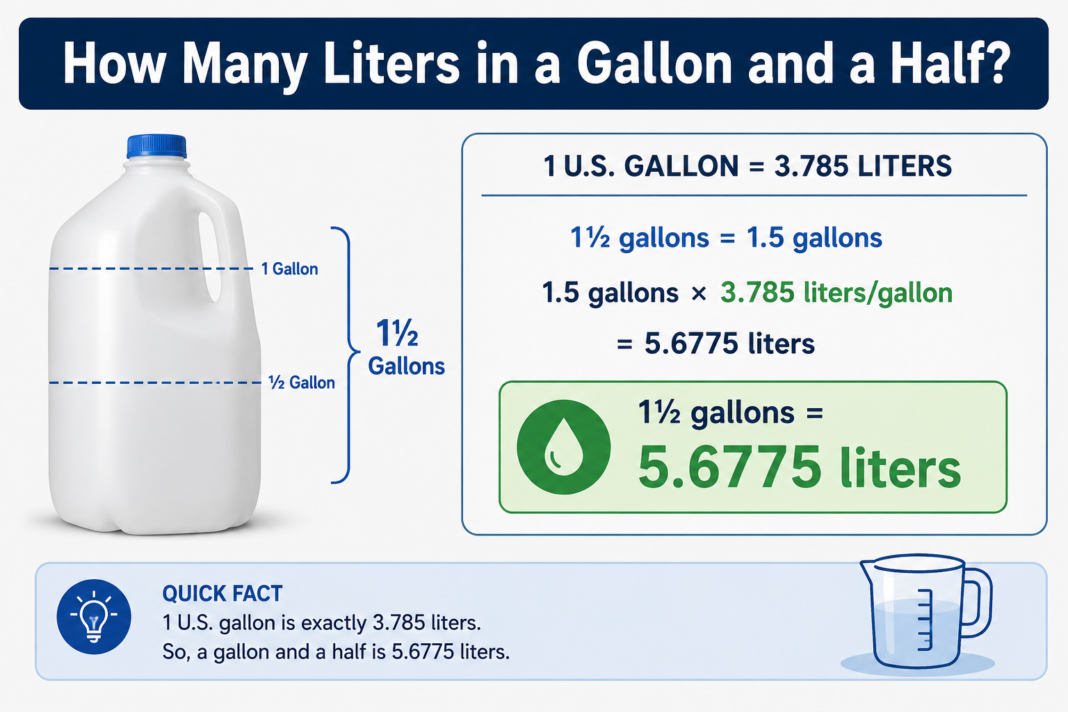

Understanding volume conversions can save time in the kitchen, at the gas station, during travel, or even while reading product labels. One of the most common questions people ask is: how many liters in a gallon and a half? The answer may sound simple, but there is more nuance than most people realize because different countries use different gallon measurements.
In the United States, 1.5 gallons equals approximately 5.68 liters. In the United Kingdom and some other regions using the imperial system, 1.5 imperial gallons equals roughly 6.82 liters. Knowing which gallon standard applies is essential for accurate conversions.
This guide explains everything you need to know about gallon-to-liter conversions, including formulas, practical examples, conversion charts, common mistakes, and real-world applications. Whether you are cooking, traveling, buying fuel, or studying measurements, this article provides a complete and accessible resource.
Understanding the Basic Conversion
When people search for how many liters in a gallon and a half, they are usually referring to the U.S. liquid gallon. In the U.S. measurement system, one gallon equals 3.785 liters. Multiplying that by 1.5 gives 5.678 liters, commonly rounded to 5.68 liters.
The confusion begins because the imperial gallon used in the UK is larger than the U.S. gallon. One imperial gallon equals 4.546 liters, meaning a gallon and a half converts to about 6.82 liters. Always check which system is being used before making calculations.
Why Gallons and Liters Are Different
Gallons belong to the imperial and customary measurement systems, while liters are part of the metric system. Most countries worldwide use liters because the metric system is standardized and easier for scientific and commercial applications.
The United States still commonly uses gallons for fuel, milk, and other liquids. This difference means international travelers, businesses, and consumers frequently need to convert between gallons and liters accurately.
Exact Answer to How Many Liters in a Gallon and a Half
For the U.S. gallon, the calculation is straightforward. Multiply 1.5 by 3.785, and the result is 5.678 liters. Rounded for convenience, the answer becomes 5.68 liters.
For the imperial gallon, multiply 1.5 by 4.546. The result is 6.819 liters, usually rounded to 6.82 liters. This distinction matters in cooking, engineering, shipping, and fuel calculations.
Quick Conversion Table
The table below shows common gallon-to-liter conversions for both U.S. and imperial measurements.
| Gallons | U.S. Liters | Imperial Liters |
| 0.5 gallon | 1.89 L | 2.27 L |
| 1 gallon | 3.79 L | 4.55 L |
| 1.5 gallons | 5.68 L | 6.82 L |
| 2 gallons | 7.57 L | 9.09 L |
| 3 gallons | 11.36 L | 13.64 L |
| 5 gallons | 18.93 L | 22.73 L |
This table helps visualize the substantial difference between the two gallon standards.
The Formula Behind the Conversion
If you want to calculate how many liters in a gallon and a half manually, the formula is simple. Multiply the number of gallons by the liter equivalent for the measurement system you are using.
For U.S. gallons, use 3.785 liters per gallon. For imperial gallons, use 4.546 liters per gallon. This formula works for any volume conversion involving gallons and liters.
Everyday Situations Where This Conversion Matters
Fuel is one of the most common examples where people need gallon-to-liter conversions. Drivers traveling internationally often see gasoline sold in liters rather than gallons, which can create confusion about fuel economy and pricing.
Cooking and beverage preparation also frequently involve these measurements. Recipes from different countries may list liquid ingredients in liters, gallons, cups, or ounces, making accurate conversion important for consistent results.
Cooking and Kitchen Measurements
Many large-batch recipes use gallons for soups, sauces, and beverages. If you are preparing drinks for events or catering services, understanding how many liters in a gallon and a half ensures accurate ingredient proportions.
For example, a punch recipe requiring 1.5 gallons of juice translates to approximately 5.68 liters in the U.S. system. That conversion can help when purchasing beverages in countries that use metric packaging.
Fuel Economy and Gasoline Conversions
Car fuel efficiency is measured differently worldwide. Americans often use miles per gallon, while many other countries measure liters per 100 kilometers. Understanding gallon-to-liter conversions bridges this gap.
Imagine filling a container with 1.5 gallons of fuel in the U.S. That amount equals roughly 5.68 liters. In the UK, the same 1.5-gallon measurement would contain significantly more fuel due to the larger imperial gallon.
Travel and International Awareness
Travelers frequently encounter volume measurement differences when purchasing drinks, fuel, or packaged liquids abroad. Understanding metric conversions can prevent confusion and overspending.
Someone moving from the United States to Europe may initially struggle with liters replacing gallons in everyday purchases. Knowing that a gallon and a half equals about 5.68 liters provides an easy mental benchmark.
Educational Importance of Unit Conversion
Students studying science, engineering, or mathematics regularly practice converting between metric and customary systems. Questions like how many liters in a gallon and a half help reinforce practical arithmetic and dimensional analysis skills.
Unit conversion also strengthens problem-solving abilities because students learn to interpret context rather than memorizing isolated numbers. Understanding systems conceptually improves long-term accuracy.
U.S. Gallon vs Imperial Gallon
The U.S. gallon is based on older wine measurements and equals 128 U.S. fluid ounces. The imperial gallon, introduced in Britain during the nineteenth century, equals 160 imperial fluid ounces.
Because the imperial gallon is larger, conversions involving liters differ considerably. Many people mistakenly assume all gallons are identical, leading to incorrect calculations in recipes, fuel estimates, and industrial settings.
Common Conversion Mistakes
One common mistake is forgetting to identify whether the gallon measurement is U.S. or imperial. This error can significantly affect precision, especially in technical or scientific applications.
Another frequent issue involves excessive rounding. While 5.68 liters is convenient for everyday use, some calculations require more precise figures like 5.678 liters to avoid accumulated inaccuracies.
How Businesses Use These Conversions
Global businesses dealing with beverages, fuel, chemicals, or manufacturing often convert between gallons and liters daily. Accurate measurements ensure compliance with international regulations and prevent costly mistakes.
Packaging labels also depend heavily on correct unit conversion. Many products sold internationally display both liters and gallons so consumers from different regions can easily understand quantities.
Scientific Perspective on Liters
A liter is a metric unit equal to one cubic decimeter. Scientists prefer liters because metric units integrate smoothly with other measurements like grams and meters.
This consistency makes calculations simpler in laboratories and industrial environments. Converting gallons to liters allows measurements to align with global scientific standards.
Historical Background of Gallons
The gallon has a long and complicated history. Different types of gallons once existed for wine, grain, and ale, creating inconsistencies across regions and industries.
Over time, the U.S. and British systems standardized their own gallon definitions. Even today, however, the two standards remain different enough to cause confusion in international communication.
Mental Math Tricks for Faster Estimates
You can estimate gallon-to-liter conversions quickly without a calculator. Since one U.S. gallon is close to 3.8 liters, multiplying by 4 and subtracting slightly gives a good approximation.
For example, 1.5 gallons times 4 equals 6 liters. Subtract a small amount, and you arrive near 5.7 liters. This shortcut works well for quick everyday calculations.
How Beverage Packaging Uses Liters
Most bottled beverages worldwide use liters for labeling. Large soda bottles, water containers, and juice packages often come in sizes like 1 liter, 1.5 liters, or 2 liters.
Someone asking how many liters in a gallon and a half may be trying to compare international packaging sizes. A 1.5-gallon container is substantially larger than a standard 2-liter bottle.
Comparing Household Containers
Visual comparisons can make measurements easier to understand. A gallon and a half is slightly less than three large 2-liter soda bottles in the U.S. system.
This practical comparison helps people estimate storage capacity, cooking volumes, or beverage requirements without relying entirely on exact numerical calculations.
Industrial and Commercial Applications
Industries such as agriculture, pharmaceuticals, and chemical manufacturing rely heavily on precise liquid measurements. Even small conversion errors can impact product quality and operational efficiency.
Commercial transport companies also convert between liters and gallons for fuel tracking, shipping documentation, and inventory management across international markets.
Why the Metric System Dominates Globally
The metric system became widely adopted because it simplifies calculations through base-10 relationships. Liters, meters, and kilograms work together seamlessly for scientific and commercial use.
Despite this global shift, gallons remain deeply embedded in American culture. That is why searches related to how many liters in a gallon and a half continue to be highly common online.
The Role of Digital Conversion Tools
Online converters and smartphone apps make unit conversion instant and convenient. These tools reduce human error and provide precise answers for gallons, liters, ounces, and many other units.
Still, understanding the underlying math remains valuable. Relying entirely on digital tools without basic conversion knowledge can create confusion when technology is unavailable.
Accuracy in Professional Environments
In healthcare, laboratory work, and engineering, precision matters enormously. Even slight conversion inaccuracies can affect formulas, measurements, or production outcomes.
Professionals therefore avoid casual rounding unless permitted by the context. They often use multiple decimal places when converting gallons into liters for official documentation.
Common Questions People Ask About Gallons and Liters
Many users searching for how many liters in a gallon and a half also wonder about related conversions involving cups, quarts, milliliters, and fluid ounces. These units all connect through broader measurement systems.
Understanding one conversion often leads naturally to mastering others. Once you know the gallon-to-liter relationship, many other volume conversions become easier to calculate mentally.
Real-World Example Scenario
Imagine planning a road trip through Europe after living in the United States. You know your emergency fuel container holds 1.5 gallons, but European gas stations measure fuel in liters.
Converting the container size to approximately 5.68 liters helps you understand fuel purchases more clearly and compare storage capacity accurately while traveling.
Educational Quote on Measurement
As physicist and mathematician Lord Kelvin famously stated, “To measure is to know.” Accurate measurement conversions allow people to communicate consistently across industries, countries, and scientific disciplines.
This quote captures why understanding conversions like gallons to liters matters in both everyday life and professional environments.
Environmental and Sustainability Relevance
Environmental reporting often uses liters when discussing water consumption, fuel usage, or industrial emissions. Understanding these units improves awareness of sustainability metrics and resource management.
Consumers comparing eco-friendly products may encounter mixed measurement systems. Knowing how many liters correspond to gallons helps interpret environmental claims more effectively.
Digital Commerce and International Shopping
Online shoppers frequently buy liquid products from international sellers. Product descriptions may list liters instead of gallons, especially for cleaning products, beverages, or automotive fluids.
Knowing that a gallon and a half equals roughly 5.68 liters helps buyers compare product sizes confidently without misunderstanding actual quantities.
Conversion Confidence for Everyday Life
Measurement confidence improves decision-making in practical situations. Whether you are cooking, traveling, purchasing fuel, or managing inventory, quick conversion knowledge reduces uncertainty.
People who regularly work with both metric and customary units eventually develop intuitive understanding, making tasks faster and more accurate over time.
Conclusion
Understanding how many liters in a gallon and a half is more useful than it may initially seem. In the U.S. system, 1.5 gallons equals approximately 5.68 liters, while in the imperial system it equals about 6.82 liters. The correct answer depends entirely on which gallon measurement is being used.
This conversion plays a role in cooking, fuel economy, travel, science, education, and global commerce. By learning the formulas, recognizing the difference between gallon systems, and practicing real-world examples, you can confidently handle volume conversions in everyday life and professional settings alike.
FAQ
How many liters in a gallon and a half in the U.S. system?
In the U.S. customary system, how many liters in a gallon and a half equals approximately 5.68 liters after rounding.
Is the imperial gallon larger than the U.S. gallon?
Yes, the imperial gallon is larger. One imperial gallon equals about 4.546 liters, while a U.S. gallon equals about 3.785 liters.
Why do some countries use liters instead of gallons?
Most countries use liters because the metric system is internationally standardized and easier for scientific, educational, and commercial applications.
How do I calculate gallons to liters manually?
Multiply the number of gallons by 3.785 for U.S. gallons or 4.546 for imperial gallons to get the equivalent in liters.
How many liters are in two gallons?
Two U.S. gallons equal approximately 7.57 liters, while two imperial gallons equal about 9.09 liters.
Can I use rounded conversions for cooking?
Yes, rounded values are usually acceptable for cooking and household use. Professional scientific or industrial work may require more precise figures.
Why is understanding how many liters in a gallon and a half important?
Knowing how many liters in a gallon and a half helps with travel, fuel calculations, recipes, shopping, and interpreting international measurements accurately.\
You May Also Read: YesMovies Alternatives Reddit