

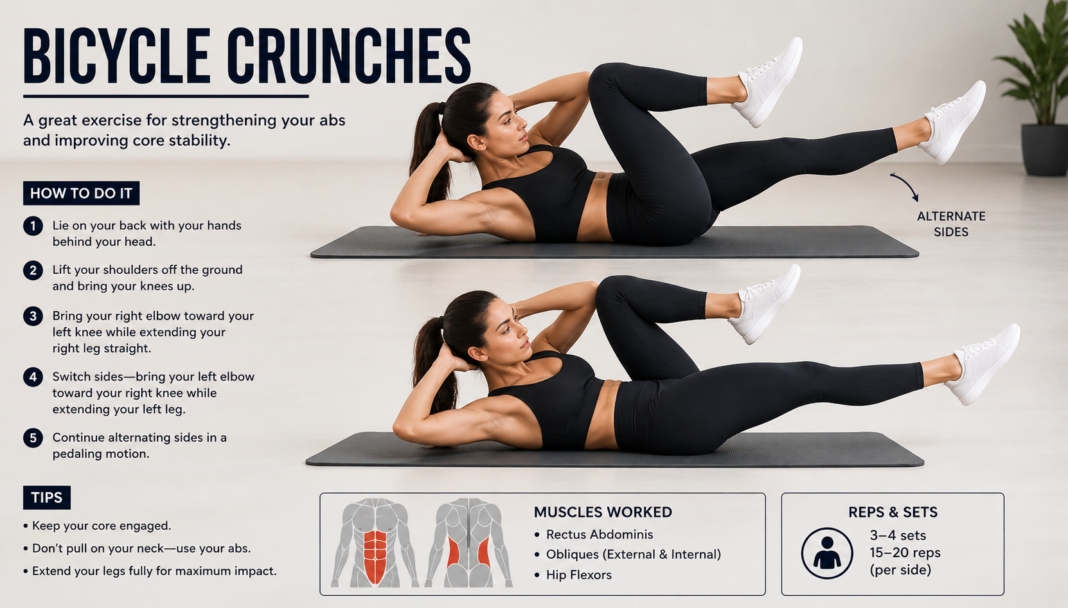

Core training remains one of the most discussed areas of fitness, yet many exercises fail to engage the abdominal muscles as effectively as people expect. Among the most respected movements in bodyweight training, bicycle crunches have earned a reputation for targeting multiple core muscles simultaneously while requiring no equipment. Whether you’re training at home, in a gym, or while traveling, this exercise offers a practical way to strengthen your midsection and improve overall movement quality.
Unlike traditional abdominal exercises that focus primarily on a single movement pattern, bicycle crunches combine rotation, flexion, and coordination. This unique combination creates a challenging workout for the rectus abdominis, obliques, and deeper stabilizing muscles. As a result, fitness professionals frequently include them in strength programs, athletic conditioning plans, and general wellness routines.
What Are Bicycle Crunches?
Bicycle crunches are a bodyweight abdominal exercise that mimics the motion of pedaling a bicycle while lying on your back. During the movement, one knee is brought toward the chest while the opposite elbow rotates toward it, creating a cross-body pattern that engages both the upper and lower portions of the core.
The exercise stands out because it challenges multiple muscle groups at once rather than isolating a single area. The coordinated twisting action requires balance, stability, and muscular control, making it a highly efficient addition to nearly any fitness program.
Why Bicycle Crunches Are So Effective
One reason bicycle crunches are widely recommended is their ability to activate the abdominal muscles through several movement planes. Many traditional ab exercises primarily involve forward flexion, but this movement adds rotational engagement that increases overall core recruitment.
The exercise also encourages muscular endurance. Since the movement alternates sides continuously, the abdominal muscles remain under tension for longer periods. This sustained effort can help improve stamina, coordination, and postural control while contributing to stronger overall core function.
The Muscles Worked During Bicycle Crunches
Understanding the muscles involved helps explain why bicycle crunches are considered one of the most complete bodyweight core exercises available. The primary target is the rectus abdominis, commonly known as the “six-pack” muscle, which assists with trunk flexion and stabilization.
Secondary muscles include the internal and external obliques, transverse abdominis, hip flexors, and supporting muscles of the lower back. Together, these structures create a coordinated system that helps stabilize the spine and transfer force efficiently throughout the body.
Core Muscle Breakdown
| Muscle Group | Primary Function | Role During Bicycle Crunches |
| Rectus Abdominis | Trunk flexion | Drives the crunching motion |
| External Obliques | Rotation and side bending | Assist torso twisting |
| Internal Obliques | Core stabilization | Support rotational movement |
| Transverse Abdominis | Deep core stability | Maintains abdominal tension |
| Hip Flexors | Hip movement | Help lift and extend legs |
| Erector Spinae | Spinal support | Provide postural control |
| Pelvic Stabilizers | Balance and alignment | Maintain proper positioning |
This combination of muscle recruitment explains why the exercise is often included in both performance training and general fitness programs.
How To Perform Bicycle Crunches Correctly
Begin by lying flat on your back with your hands lightly supporting the sides of your head. Lift your shoulders off the floor and raise your legs so your knees form roughly a ninety-degree angle.
Extend one leg while simultaneously rotating your torso and bringing the opposite elbow toward the bent knee. Alternate sides in a smooth, controlled manner while maintaining tension through your abdominal muscles and avoiding excessive pulling on the neck.
Proper Form Fundamentals
Form is the difference between an effective core exercise and an uncomfortable one. The movement should originate from the torso rather than the arms. Your elbows should remain wide, allowing the abdominal muscles to drive the rotation naturally.
Breathing also matters significantly. Exhale during the twisting phase and inhale during the transition. Consistent breathing patterns help maintain stability while encouraging better muscular engagement throughout each repetition.
Common Mistakes That Limit Results
Many people perform bicycle crunches too quickly, turning the exercise into a momentum-driven movement. Speed often reduces muscle activation and decreases the effectiveness of each repetition. Controlled motion typically produces better outcomes.
Another frequent mistake involves pulling on the head or neck. This compensation strategy shifts stress away from the abdominal muscles and may create discomfort. Instead, keep the neck relaxed and focus on rotating the rib cage toward the opposite knee.
Benefits for Core Strength
A strong core contributes to nearly every physical activity, from lifting groceries to participating in competitive sports. Bicycle crunches help develop strength throughout the abdominal wall, creating a more stable foundation for movement.
Improved core strength can also enhance body control and movement efficiency. When the trunk is capable of resisting unwanted motion, the arms and legs can generate force more effectively, leading to better overall physical performance.
Benefits for Athletic Performance
Athletes frequently rely on rotational power and stability. Sports such as tennis, baseball, soccer, basketball, golf, and martial arts all require efficient force transfer through the torso. Exercises that train rotational control can therefore provide meaningful performance benefits.
Because bicycle crunches incorporate twisting and stabilization, they help develop movement patterns that resemble many athletic actions. This makes them valuable not only for aesthetics but also for functional athletic development.
The Relationship Between Bicycle Crunches and Visible Abs
One of the most common misconceptions in fitness is that abdominal exercises alone create visible abs. While bicycle crunches strengthen and develop the abdominal muscles, muscle definition is also heavily influenced by overall body fat levels.
Visible abdominal definition generally results from a combination of resistance training, cardiovascular activity, consistent nutrition, adequate sleep, and overall energy balance. Core exercises support this process by strengthening the underlying musculature.
Weight Loss and Calorie Burning
Although bicycle crunches are not among the highest-calorie-burning exercises available, they contribute to overall activity levels and can be included in calorie-burning workouts. When combined with other movements, they help increase training volume and muscular engagement.
For individuals pursuing fat loss, the exercise works best as part of a comprehensive fitness strategy that includes strength training, cardiovascular exercise, and dietary consistency. Sustainable habits remain more important than any single movement.
Bicycle Crunches Versus Traditional Crunches
Traditional crunches primarily focus on spinal flexion and target the rectus abdominis. While they can be effective, they typically involve less rotational engagement and recruit fewer supporting muscles.
Bicycle crunches add an element of rotation and coordination, creating a broader challenge for the core. This additional complexity often results in greater overall muscle activation and improved functional carryover to everyday activities.
Bicycle Crunches Versus Sit-Ups
Sit-ups involve a larger range of motion and greater hip flexor involvement. Some individuals find them useful for endurance and conditioning, while others prefer exercises that place less stress on the lower back.
In comparison, bicycle crunches often allow users to maintain more consistent abdominal tension throughout the movement. This can make them a preferred option for those seeking focused core engagement.
Beginner-Friendly Modifications
Not everyone can immediately perform the exercise with ideal technique. Beginners may benefit from keeping their feet slightly higher off the floor or slowing the movement significantly.
Another useful modification involves pausing briefly between repetitions. This creates greater control and allows individuals to focus on quality movement rather than repetition count.
Intermediate Progression Strategies
As strength improves, increasing time under tension can enhance the challenge. Slower repetitions, extended holds, and stricter form standards all contribute to greater muscular demand.
Adding bicycle crunches into circuits with planks, mountain climbers, and leg raises can further elevate training intensity while improving overall core endurance.
Advanced Variations for Experienced Exercisers
Advanced athletes often seek ways to increase complexity without sacrificing form. Weighted bicycle crunches, tempo-focused repetitions, and extended isometric holds are popular progression methods.
Some trainers also combine the movement with high-intensity interval training sessions. This approach challenges cardiovascular fitness while maintaining a strong emphasis on core development.
Injury Prevention and Core Stability
A stable core helps distribute forces throughout the body more efficiently. When trunk muscles function properly, stress on surrounding joints may be reduced during daily activities and athletic movements.
Consistent core training can support better movement mechanics, balance, and body awareness. While no exercise guarantees injury prevention, a stronger and more coordinated core contributes to overall resilience.
How Often Should You Do Bicycle Crunches?
Training frequency depends on individual goals, recovery capacity, and overall program design. Many people benefit from including core-focused exercises two to four times per week as part of a balanced routine.
Quality generally matters more than quantity. Performing fewer repetitions with excellent form often produces better long-term results than completing large volumes with poor technique.
Integrating Bicycle Crunches Into a Workout Program
The exercise works well in multiple training environments. It can serve as part of a warm-up, a dedicated core session, a conditioning circuit, or a workout finisher.
Because it requires minimal space and equipment, it is especially useful for home workouts. This convenience makes it easier to maintain consistency regardless of schedule or training location.
The Mind-Muscle Connection Advantage
Many exercisers underestimate the importance of intentional muscle engagement. Focusing on abdominal contraction during bicycle crunches can significantly improve exercise effectiveness.
Instead of merely moving through repetitions, concentrate on rotating through the torso and actively squeezing the abdominal muscles. This approach often results in greater muscular activation and improved training outcomes.
Expert Perspective on Core Training
Fitness professionals increasingly emphasize movement quality over repetition quantity. Effective core training is not simply about performing hundreds of repetitions; it involves developing strength, control, and coordination.
As strength coach Stuart McGill famously noted, “Spine stability is achieved with a balance of stiffness and movement.” This perspective highlights why well-executed rotational exercises can play an important role in comprehensive core development.
Why Consistency Matters More Than Intensity
Many people search for the perfect abdominal exercise while overlooking the importance of consistency. Even highly effective movements produce limited results when performed sporadically.
Regular practice, progressive overload, and proper recovery create the foundation for meaningful improvements. Over time, small improvements accumulate into noticeable gains in strength, endurance, and body control.
Conclusion
Bicycle crunches remain one of the most effective bodyweight exercises for strengthening the core, improving rotational control, and enhancing overall fitness. Their ability to engage multiple muscle groups simultaneously makes them a valuable addition to nearly any workout program.
Whether your goal is building stronger abs, improving athletic performance, enhancing posture, or developing better movement quality, this exercise offers substantial benefits. When performed with proper technique and incorporated into a balanced fitness plan, bicycle crunches can help create a stronger, more resilient, and more functional core.
FAQ
Are bicycle crunches better than regular crunches?
Many people find bicycle crunches more effective because they engage both the rectus abdominis and the obliques through rotational movement, creating greater overall core activation.
How many bicycle crunches should I do each day?
The ideal amount depends on your fitness level, but most individuals benefit from two to four sets of bicycle crunches performed with controlled technique rather than high repetition counts.
Do bicycle crunches help burn belly fat?
Bicycle crunches strengthen abdominal muscles, but reducing belly fat requires an overall calorie deficit supported by nutrition, exercise, and lifestyle habits.
Can beginners perform bicycle crunches safely?
Yes, beginners can perform bicycle crunches by moving slowly, reducing range of motion if needed, and focusing on proper form before increasing intensity.
Why do I feel bicycle crunches in my neck?
Neck discomfort often occurs when people pull on their head during bicycle crunches. Keeping the neck relaxed and rotating from the torso can help reduce strain.
Are bicycle crunches good for athletes?
Bicycle crunches can support athletic performance because they develop rotational strength, core stability, and coordination that transfer to many sports and physical activities.
How long does it take to see results from bicycle crunches?
Results vary, but consistent bicycle crunches combined with a structured fitness and nutrition plan can contribute to noticeable improvements in core strength within several weeks.
You May Also Read: Head of Household vs Single