

In the world of advertising, presentation often determines perception. A brilliant design can lose its impact if it is displayed poorly, while a well-presented concept can instantly capture attention and secure stakeholder approval. This is where the billboard mockup becomes an essential tool for designers, agencies, marketers, and brands seeking to visualize outdoor advertising campaigns before they go live.
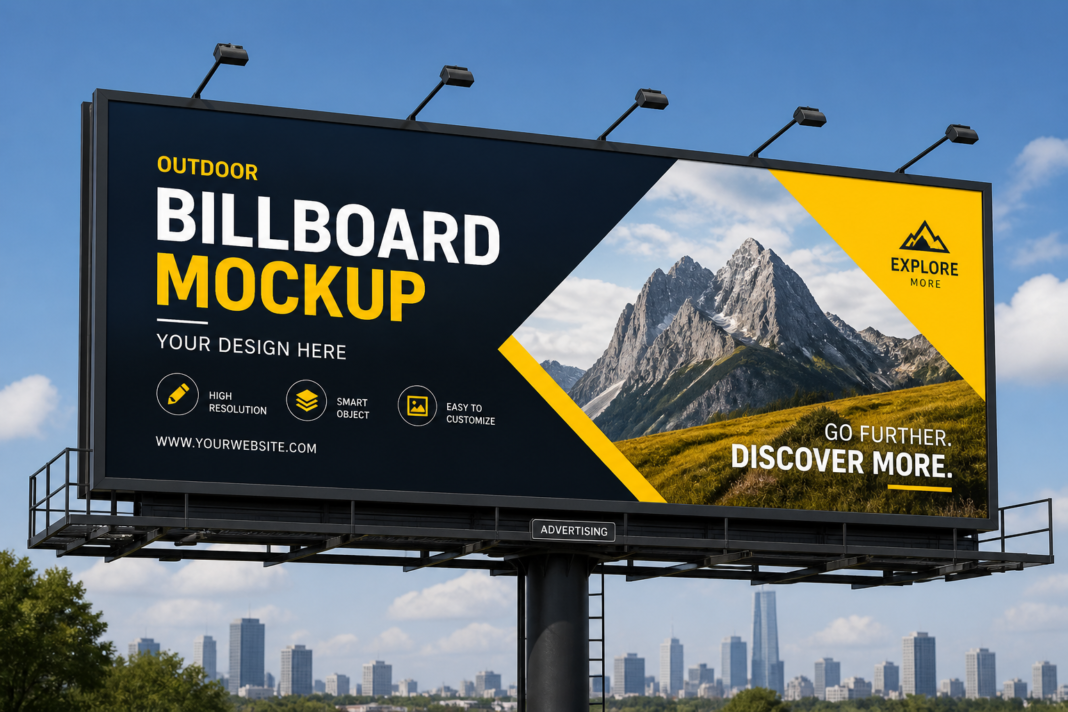
A billboard mockup transforms a flat design into a realistic visual representation of how an advertisement will appear in a real-world environment. Whether the goal is client approval, portfolio enhancement, campaign pitching, or marketing visualization, mockups help bridge the gap between concept and execution. They provide context, scale, realism, and emotional impact that standard design files cannot deliver.
As outdoor advertising continues to evolve alongside digital marketing channels, billboard presentations have become increasingly sophisticated. Modern mockups incorporate realistic lighting, environmental details, perspective corrections, and high-resolution imagery that accurately simulate actual advertising placements. This allows stakeholders to evaluate effectiveness long before production begins.
This comprehensive guide explores everything professionals need to know about billboard mockup creation, usage, strategy, optimization, and industry best practices.
Understanding Billboard Mockups
A billboard mockup is a visual presentation template that showcases an advertisement design within a realistic billboard setting. Instead of viewing artwork on a blank canvas, stakeholders see how the advertisement appears on a highway billboard, urban display, building facade, roadside structure, or digital screen.
The primary purpose of a billboard mockup is visualization. Clients, creative directors, and marketing teams often struggle to imagine how a design will appear at full scale. A realistic mockup eliminates uncertainty by placing artwork into a contextual environment, helping everyone evaluate visibility, readability, branding impact, and overall effectiveness.
Why Billboard Mockups Matter in Modern Advertising
Advertising decisions frequently involve substantial investments, making accurate visual representation crucial during planning stages. A billboard mockup reduces risk by helping decision-makers identify potential issues before production and installation costs are incurred.
Mockups also enhance communication between designers and clients. Rather than discussing abstract concepts, teams can evaluate tangible visuals that demonstrate exactly how an outdoor campaign may appear in real-world conditions, leading to faster approvals and more productive feedback.
The Evolution of Outdoor Advertising Visualization
Years ago, designers relied on sketches, printed proofs, or rough photo manipulations to communicate outdoor advertising concepts. These methods often lacked realism and required significant effort to update when revisions were needed.
Today’s billboard mockup solutions leverage advanced editing software, smart object technology, realistic photography, and environmental effects. The result is highly convincing presentations that accurately represent large-format advertising campaigns across diverse locations and scenarios.
Types of Billboard Mockups Available
Outdoor advertising encompasses a wide variety of formats, and mockups have evolved to match these environments. Traditional roadside billboards remain popular, but urban placements, transit advertising, building wraps, and digital displays now require specialized visualization templates.
Designers can choose from highway billboard scenes, cityscape displays, rooftop structures, construction-site billboards, illuminated night scenes, transit corridor placements, and digital outdoor advertising environments. Each type serves different campaign objectives and audience contexts.
Traditional Roadside Billboard Mockups
Roadside billboard presentations remain among the most commonly used formats because they reflect classic outdoor advertising environments. These mockups often feature highways, open roads, vehicles, and expansive landscapes that emphasize visibility and scale.
Such presentations help marketers evaluate how designs perform at viewing distances. Elements like typography size, color contrast, and messaging hierarchy become easier to assess when viewed within a realistic roadside setting.
Urban Billboard Mockups
Urban advertising environments present unique challenges and opportunities. City billboards compete with buildings, traffic, signage, and dense visual activity, making contextual presentation especially important.
An urban billboard mockup allows designers to test whether advertisements stand out amid the complexity of metropolitan environments. These visuals are particularly valuable for retail brands, entertainment campaigns, technology companies, and consumer-focused promotions.
Digital Billboard Mockups
Digital outdoor advertising has expanded rapidly, creating demand for realistic digital display visualizations. These mockups simulate LED screens, dynamic advertising boards, and electronic outdoor media placements.
Because digital screens often feature vibrant illumination and advanced display characteristics, specialized billboard mockup templates help demonstrate how creative assets will appear during both daytime and nighttime viewing conditions.
Benefits for Graphic Designers
For graphic designers, mockups provide an opportunity to present work professionally and persuasively. A realistic visualization immediately elevates perceived quality and helps communicate creative intent more effectively than flat artwork files.
Mockups also strengthen portfolios. Potential clients often prefer seeing finished concepts in realistic settings because they demonstrate practical application rather than isolated design execution. This added context can significantly improve presentation quality and project acquisition rates.
Benefits for Marketing Agencies
Marketing agencies frequently use billboard mockup presentations during campaign pitches and strategy meetings. Visualizing concepts within real-world environments helps agencies demonstrate creative vision while supporting broader marketing narratives.
These presentations often improve client confidence because they illustrate campaign execution clearly. Instead of relying solely on explanations, agencies can show exactly how outdoor advertising will integrate into larger branding initiatives.
Benefits for Brands and Businesses
Brands benefit from improved decision-making when evaluating creative concepts. Realistic visualizations help executives assess whether designs align with brand identity, messaging objectives, and audience expectations.
A billboard mockup also allows internal teams to compare multiple creative directions efficiently. By viewing competing concepts within identical environments, stakeholders can make more informed choices based on visual performance rather than subjective assumptions.
Essential Elements of a High-Quality Billboard Mockup
The effectiveness of a mockup depends largely on realism and attention to detail. High-quality templates accurately replicate perspective, lighting conditions, shadows, textures, and environmental interactions.
Successful presentations also maintain image quality. Sharp photography, realistic scaling, proper placement, and seamless integration ensure that viewers focus on the advertisement rather than noticing technical inconsistencies within the visualization.
Choosing the Right Environment
The environment surrounding an advertisement influences how audiences perceive the message. Selecting an appropriate mockup setting therefore plays a critical strategic role in campaign presentation.
A luxury brand may benefit from a sophisticated urban backdrop, while a travel company might perform better within an open-road environment. Matching context to campaign objectives enhances realism and strengthens emotional connection.
Billboard Mockups and Client Approvals
One of the most valuable applications of a billboard mockup is streamlining client approval processes. Clients often struggle to interpret design files because they lack visual context regarding size, scale, and placement.
Realistic mockups reduce ambiguity. When stakeholders see an advertisement positioned within its intended environment, discussions become more focused, revisions become more precise, and approvals often occur more quickly.
Creating a Billboard Mockup from Scratch
Building a custom mockup begins with selecting a suitable photograph or creating a 3D scene. The chosen environment should reflect the intended advertising placement while providing sufficient resolution for professional presentation.
After establishing the scene, designers align artwork using perspective transformations, masking techniques, and realistic environmental adjustments. Shadows, reflections, and lighting refinements help integrate the design naturally into the surrounding environment.
Using Smart Objects for Efficiency
Many professional templates utilize smart object functionality to simplify editing. Designers can insert artwork into a designated layer, and the mockup automatically applies perspective and placement adjustments.
This workflow dramatically improves efficiency. Instead of manually rebuilding presentations for each revision, designers can update artwork quickly while maintaining consistent quality and realism across multiple concepts.
Common Design Mistakes in Billboard Presentations
One frequent mistake involves overcrowding advertisements with excessive information. Since billboards are often viewed briefly from significant distances, simplicity typically improves effectiveness and readability.
Another issue is unrealistic scaling. Designs that appear too small, stretched, distorted, or improperly aligned can undermine credibility. Maintaining accurate proportions ensures that the billboard mockup remains believable and professional.
Readability and Viewing Distance Considerations
Outdoor advertising differs significantly from digital and print media because viewers often have only a few seconds to absorb information. Effective billboard design prioritizes clarity, hierarchy, and visual impact.
Mockups provide an excellent opportunity to test readability. By evaluating typography, spacing, and message structure within realistic viewing conditions, designers can optimize communication before production begins.
The Role of Photography in Mockup Quality
Photography serves as the foundation of most billboard presentations. High-resolution images with strong composition, natural lighting, and authentic environmental detail significantly enhance realism.
Professional-quality photography also contributes to emotional engagement. A compelling scene helps audiences imagine the campaign in operation, creating stronger connections between concept, brand, and intended outcome.
Billboard Mockups for Portfolio Development
Portfolios that include realistic advertising presentations often appear more polished and professional. Rather than displaying isolated artwork, designers demonstrate how their concepts function in practical marketing environments.
A carefully crafted billboard mockup can transform a standard portfolio piece into a compelling case study. This contextual approach helps prospective clients understand strategic thinking as well as design capability.
Industry Applications Beyond Advertising
Although commonly associated with advertising, mockups are valuable across numerous industries. Real estate developers, event organizers, political campaigns, educational institutions, and nonprofit organizations all use billboard visualizations.
These organizations often rely on mockups to secure approvals, attract sponsors, communicate concepts, and present marketing plans. The ability to visualize large-scale messaging remains valuable regardless of industry sector.
Billboard Mockups and Brand Consistency
Maintaining consistent brand presentation across marketing channels is essential for building recognition and trust. Mockups help verify that outdoor advertising aligns with broader branding standards.
By reviewing advertisements within realistic settings, teams can evaluate color accuracy, logo visibility, typography consistency, and overall brand presence before campaigns reach public audiences.
Comparing Popular Billboard Mockup Styles
Different presentation styles serve different purposes depending on audience expectations, project goals, and creative direction. Understanding these distinctions helps professionals select the most effective format.
The following table outlines common billboard mockup styles and their primary applications.
| Mockup Style | Primary Use | Strengths | Ideal Audience |
| Highway Billboard | Outdoor advertising campaigns | Emphasizes scale and visibility | Brands, agencies |
| Urban Billboard | City marketing campaigns | Realistic metropolitan context | Retail, entertainment |
| Rooftop Billboard | Premium brand promotion | Strong visual impact | Luxury brands |
| Digital Billboard | LED advertising campaigns | Modern appearance | Technology companies |
| Night Scene Billboard | Illuminated campaigns | Highlights lighting effects | Event marketing |
| Construction Billboard | Development projects | Project visibility | Real estate firms |
| Transit Billboard | Transportation advertising | Audience movement context | Public campaigns |
Trends Shaping Billboard Mockup Design
Modern presentation trends increasingly emphasize realism, environmental storytelling, and immersive visualization. Designers are moving beyond simple placements toward scenes that communicate atmosphere, audience context, and brand personality.
Advancements in 3D rendering, AI-assisted workflows, and high-resolution photography continue to expand creative possibilities. As presentation standards rise, mockups are becoming more sophisticated and strategically important.
The Psychology Behind Effective Visual Presentations
People naturally respond more strongly to visuals than abstract descriptions. A realistic billboard mockup leverages this tendency by transforming concepts into experiences that feel tangible and believable.
Research in marketing consistently demonstrates that visual context improves comprehension, recall, and decision-making. When stakeholders can imagine a campaign in operation, confidence and engagement often increase substantially.
Measuring Presentation Effectiveness
Although mockups are visualization tools rather than live advertisements, their effectiveness can still be evaluated. Stakeholder engagement, approval speed, revision frequency, and presentation outcomes provide useful indicators.
Successful presentations typically generate clear feedback, reduce misunderstandings, and facilitate decision-making. These practical outcomes often translate into more efficient creative workflows and stronger client relationships.
Best Practices for Professional Results
Professional presentations prioritize realism, relevance, and simplicity. Every visual element should support the central objective of communicating how an advertisement will function in its intended environment.
As renowned designer Paul Rand once noted, “Design is the silent ambassador of your brand.” That principle applies equally to mockups, where presentation quality directly influences how creative work is perceived and evaluated.
Conclusion
The billboard mockup has become an indispensable asset in modern advertising, design, branding, and marketing workflows. By transforming flat artwork into realistic visual experiences, mockups help stakeholders understand, evaluate, and approve creative concepts with greater confidence.
Whether used for client presentations, portfolio development, campaign planning, or strategic decision-making, a high-quality billboard mockup delivers clarity, professionalism, and persuasive visual impact. As outdoor advertising continues to evolve, the ability to present ideas effectively will remain a critical competitive advantage for designers, agencies, and brands alike.
FAQ
What is a billboard mockup?
A billboard mockup is a realistic visual template that displays advertising artwork within a simulated outdoor environment, helping stakeholders evaluate design effectiveness before production.
Why do designers use a billboard mockup?
Designers use a billboard mockup to present concepts professionally, improve client understanding, and demonstrate how advertisements will appear in real-world settings.
Can a billboard mockup improve client approvals?
Yes, a billboard mockup reduces uncertainty by providing visual context, making it easier for clients to understand and approve advertising concepts.
What software is commonly used to create billboard mockups?
Most professionals create billboard mockup presentations using graphic design software that supports smart objects, perspective editing, masking, and photo manipulation.
Are billboard mockups useful for portfolios?
Absolutely. A billboard mockup helps showcase design work in realistic applications, making portfolios more engaging and persuasive for potential clients.
What makes a billboard mockup look realistic?
Realistic lighting, accurate perspective, high-resolution photography, proper scaling, and seamless integration of artwork all contribute to an effective billboard mockup.
Can digital billboard campaigns use a billboard mockup?
Yes. Digital outdoor advertising frequently relies on billboard mockup templates to visualize LED screens, electronic displays, and dynamic advertising environments.
You May Also Read: Bicycle Crunches