


Pokémon cards have become far more than a trading card game. They are collectibles, investments, nostalgic keepsakes, and competitive gaming tools used by millions of players and collectors worldwide. Whether you’re protecting a rare holographic card, designing custom proxies, organizing a collection, or purchasing storage accessories, understanding pokemon card dimensions is essential.
The size of a Pokémon card may appear simple at first glance, but card measurements influence everything from gameplay and tournament legality to sleeve compatibility, grading submissions, binder organization, and long-term preservation. Even slight deviations in dimensions can impact card authenticity, handling, and storage.
This comprehensive guide explores official sizing standards, measurement specifications, comparisons with other trading card games, storage considerations, printing details, and common misconceptions. By the end, you’ll have a complete understanding of pokemon card dimensions and why they matter to collectors, players, sellers, and enthusiasts alike.
What Are the Official Pokémon Card Dimensions?
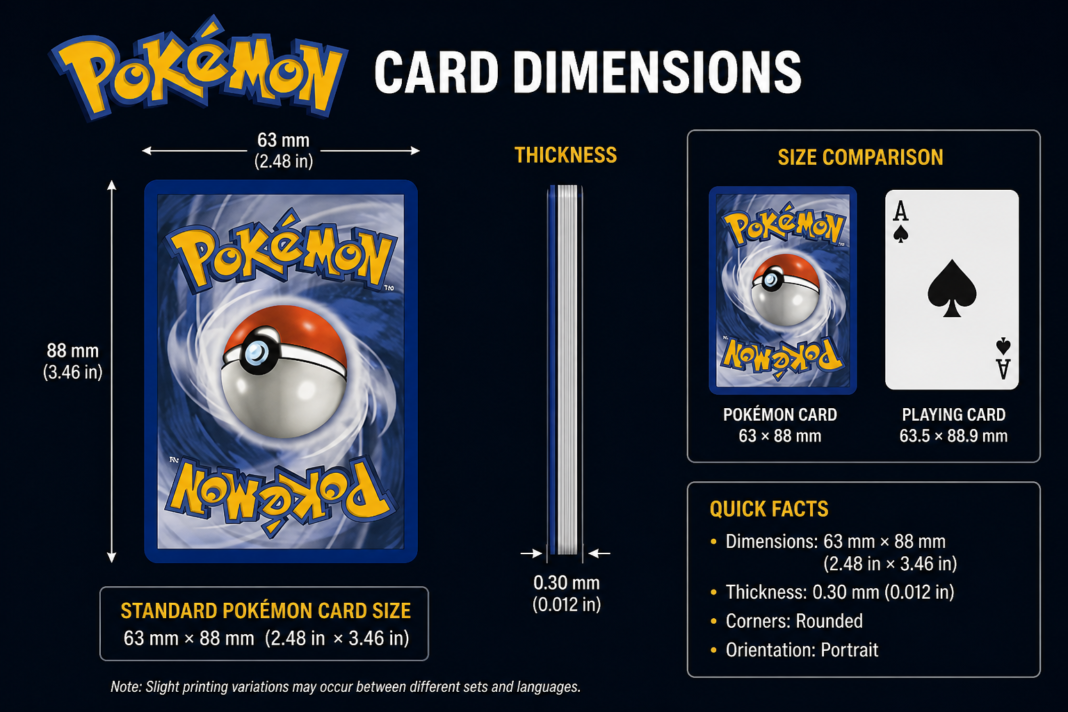
The official pokemon card dimensions used by The Pokémon Company follow the standard trading card format commonly known as “standard size.” An authentic Pokémon card measures approximately 2.5 inches wide by 3.5 inches tall, or 63 mm by 88 mm.
This sizing standard has remained remarkably consistent throughout the history of the Pokémon Trading Card Game. From early Base Set cards to modern Scarlet & Violet releases, maintaining a uniform size allows cards from different eras to remain compatible with decks, sleeves, binders, and tournament play requirements.
Because consistency is critical in competitive environments, manufacturers maintain tight production tolerances. Minor manufacturing variations may occur, but official cards remain extremely close to standard dimensions. Significant differences often raise concerns regarding authenticity, trimming, or production defects.
Why Pokémon Card Size Matters
Card dimensions affect much more than appearance. Proper sizing ensures cards shuffle consistently, fit storage products correctly, and remain fair during gameplay. Tournament officials rely on standardized sizing to prevent marked or altered cards from creating competitive advantages.
Collectors also benefit from dimensional consistency. Protective sleeves, top loaders, magnetic holders, grading slabs, and binder pages are all designed around standard measurements. Understanding pokemon card dimensions helps collectors avoid purchasing accessories that are too small or excessively large.
Size accuracy becomes particularly important when dealing with high-value cards. A card that has been trimmed or altered can lose substantial value, making dimensional verification an important step during authentication and grading.
Pokémon Card Measurement Breakdown
While the standard measurement is straightforward, several individual dimensional elements contribute to the overall structure of a Pokémon card. These include width, height, corner radius, thickness, and border proportions.
The following table provides a detailed breakdown of standard Pokémon card measurements and related specifications.
| Specification | Measurement |
| Width | 2.5 inches (63 mm) |
| Height | 3.5 inches (88 mm) |
| Aspect Ratio | Approximately 1:1.4 |
| Card Category | Standard Trading Card |
| Typical Thickness | Around 0.30 mm |
| Compatible Sleeve Size | 66 x 91 mm |
| Compatible Top Loader | 3 x 4 inches |
| Common Binder Pocket | Standard Card Pocket |
| Grading Compatibility | PSA, BGS, CGC Standard Holders |
| Tournament Standard | Official Pokémon TCG |
These measurements provide the foundation for virtually every Pokémon card accessory available on the market today.
Comparing Pokémon Cards to Other Trading Cards
Many collectors own cards from multiple trading card games. Fortunately, Pokémon cards share dimensions with several major card games, making storage solutions highly interchangeable.
For example, Pokémon cards use the same standard size as baseball cards and Magic: The Gathering cards. This cross-compatibility allows collectors to use many of the same sleeves, binders, and protective products across multiple hobbies without needing specialized equipment.
However, not every trading card game follows identical standards. Some games use slightly different dimensions, while mini cards and oversized promotional cards may require unique storage solutions.
How Pokémon Card Dimensions Compare to Magic: The Gathering
One of the most common questions among collectors concerns compatibility between Pokémon and Magic cards. Both games use the standard 63 mm by 88 mm format.
As a result, sleeves marketed for Magic: The Gathering generally fit Pokémon cards perfectly. This compatibility benefits collectors by increasing product availability and creating a broader range of premium protection options.
Many professional collectors actually use the same storage systems for both games. Standard-size deck boxes, premium binders, and archival storage products typically accommodate either card type without issue.
Pokémon Card Thickness and Material Construction
While most discussions focus on width and height, thickness also plays an important role. Official Pokémon cards consist of layered cardstock designed to balance durability with flexibility.
A typical Pokémon card is roughly 0.30 millimeters thick, though slight variations may occur between print runs and manufacturing facilities. Thickness helps maintain card integrity during shuffling and handling while supporting advanced printing techniques such as foil layers and textured finishes.
Collectors examining potentially counterfeit cards often compare thickness alongside weight, dimensions, color saturation, and light-test characteristics. Thickness alone does not prove authenticity, but it contributes valuable information during inspection.
Understanding Oversized Pokémon Cards
Not all Pokémon cards follow standard measurements. Throughout the franchise’s history, various oversized promotional cards have been released in special collections and boxed products.
These jumbo cards are intentionally larger than standard cards and are typically intended for display rather than gameplay. Their dimensions vary depending on the release era, making specialized storage solutions necessary for collectors who wish to preserve them safely.
Because oversized cards are promotional items, they are generally not legal for standard tournament play. Their primary purpose is collecting, showcasing artwork, and enhancing premium product offerings.
Mini Pokémon Cards and Alternative Formats
In addition to jumbo cards, some Pokémon products include miniature cards designed for novelty and collector appeal. These cards intentionally depart from official tournament sizing standards.
Mini cards often feature reduced artwork and text scaling while preserving the appearance of traditional Pokémon cards. Because they differ significantly from official pokemon card dimensions, standard sleeves and storage accessories usually do not fit them properly.
Collectors interested in specialty releases should verify product measurements before purchasing protective accessories. Custom-sized storage products may be required.
Sleeve Compatibility and Protection Standards
One of the most practical reasons to understand pokemon card dimensions involves sleeve selection. Sleeves protect cards from scratches, fingerprints, moisture, dust, and handling wear.
Most sleeve manufacturers design products specifically for standard-size trading cards. A common sleeve measurement is approximately 66 mm by 91 mm, providing a small margin around the card for easy insertion while maintaining a secure fit.
Competitive players often use double-sleeving techniques, combining inner sleeves with outer sleeves for maximum protection. Because standard Pokémon dimensions are consistent, double-sleeving systems work reliably across most modern card releases.
Choosing the Right Top Loaders
Top loaders provide rigid protection and are commonly used for valuable cards. These hard plastic holders prevent bending and reduce handling risks during storage and shipping.
Standard 3-inch by 4-inch top loaders are designed specifically for cards matching official Pokémon dimensions. Collectors frequently combine penny sleeves with top loaders to create an additional protective barrier.
This combination is particularly useful when transporting high-value cards, submitting cards for grading, or preparing collectibles for sale through online marketplaces.
Binder Storage Considerations
Binders remain one of the most popular methods for organizing Pokémon collections. Modern binder pages are generally built around standard trading card measurements.
A well-designed binder pocket accommodates sleeved Pokémon cards without excessive movement. Proper fit minimizes corner wear and reduces the likelihood of cards slipping from pockets during transportation.
Collectors managing large collections often organize cards by set, rarity, species, or grading potential. Consistent dimensions make these organizational systems practical and scalable.
How Grading Companies Verify Dimensions
Professional grading services carefully inspect card dimensions during the authentication process. Companies evaluate whether a card maintains its original factory size and shape.
Cards that have been trimmed often exhibit altered edges, reduced dimensions, or abnormal corner characteristics. Even small changes can significantly affect grading outcomes because originality is a critical component of card value.
For collectors submitting expensive cards, dimensional integrity is just as important as surface condition, centering, corners, and edges.
Printing Custom Pokémon-Style Cards
Custom card creators frequently need accurate sizing references. Whether producing fan art cards, proxies, display pieces, or design mockups, precise measurements ensure professional-looking results.
Designers typically use the standard 63 mm by 88 mm dimensions as a template. Maintaining accurate proportions helps artwork align naturally with familiar Pokémon card aesthetics.
While custom cards can be enjoyable creative projects, they should never be represented as authentic products. Clear differentiation helps preserve trust within the collecting community.
Common Misconceptions About Card Size
A widespread misconception is that older Pokémon cards were physically larger or smaller than modern releases. In reality, official card dimensions have remained remarkably consistent throughout the game’s history.
Another misunderstanding involves slight manufacturing variances. Small production differences do not necessarily indicate counterfeit cards. Professional evaluation considers multiple factors rather than relying solely on measurements.
As many experienced collectors note, “Authenticity is determined by a combination of characteristics, not a single measurement.” This perspective reflects the nuanced approach used by grading professionals and advanced hobbyists.
Pokémon Card Dimensions and Counterfeit Detection
Dimension checking is one tool collectors use when evaluating questionable cards. Counterfeit cards occasionally display noticeable size inconsistencies due to inaccurate printing and cutting processes.
A card that appears unusually narrow, short, wide, or tall compared to authentic examples deserves closer inspection. However, dimensional analysis should always be combined with examinations of print quality, texture, color, cardstock, and edge construction.
Experienced collectors typically compare suspected cards directly against verified authentic copies. Side-by-side comparison often reveals discrepancies quickly and effectively.
International Printing Variations
Pokémon cards are printed in multiple regions and languages, serving a global audience of collectors and players. Despite differences in language and manufacturing location, official dimensions remain standardized.
This consistency ensures compatibility across products worldwide. A Japanese Pokémon card and an English Pokémon card fit the same sleeves, binders, and storage products despite being produced for different markets.
Standardization also supports international tournaments, collecting communities, and secondary market transactions by maintaining predictable sizing expectations.
How Dimensions Affect Card Value
Dimensions indirectly influence card value through authenticity verification and grading outcomes. A card retaining its original factory dimensions is more likely to achieve favorable grading results.
Collectors purchasing expensive vintage cards often verify measurements before completing transactions. Trimmed cards may appear visually attractive yet suffer significant reductions in market value.
Understanding pokemon card dimensions helps buyers make informed decisions and avoid costly mistakes when evaluating high-end collectibles.
Best Storage Practices for Long-Term Preservation
Proper storage begins with choosing accessories designed around official dimensions. Sleeves, binders, top loaders, and archival containers should all accommodate cards without excessive compression or movement.
Environmental conditions matter just as much as physical protection. Stable temperature, controlled humidity, and minimal exposure to sunlight help preserve card quality over time.
Combining correct storage methods with an understanding of standard sizing creates a strong foundation for long-term collection management. Even common cards benefit from careful handling and organization.
The Evolution of Pokémon Card Production
Although card dimensions have remained stable, manufacturing technology has evolved significantly. Modern printing techniques allow for textured surfaces, enhanced foil treatments, richer colors, and improved durability.
These advancements demonstrate how Pokémon cards can innovate visually while maintaining dimensional consistency. Collectors enjoy new design features without sacrificing compatibility with existing storage systems.
The balance between innovation and standardization has helped sustain the Pokémon Trading Card Game’s popularity for decades.
Conclusion
Understanding pokemon card dimensions is essential for collectors, players, investors, sellers, and hobby enthusiasts alike. The official size of 2.5 inches by 3.5 inches, or 63 mm by 88 mm, serves as the foundation for gameplay, storage, grading, protection, and authentication.
Whether you’re buying sleeves, organizing binders, identifying counterfeits, submitting cards for grading, or creating custom designs, accurate dimensional knowledge helps you make informed decisions. While specialty products such as jumbo and mini cards exist, standard Pokémon cards remain remarkably consistent across generations and regions.
By mastering pokemon card dimensions and their practical implications, you can better protect your collection, avoid common mistakes, and navigate the hobby with greater confidence.
FAQ
What are the official Pokémon card dimensions?
The official pokemon card dimensions are 2.5 inches by 3.5 inches, which equals approximately 63 mm by 88 mm.
Are Pokémon cards the same size as Magic: The Gathering cards?
Yes. Pokémon cards and Magic: The Gathering cards share the same standard dimensions, allowing them to use many of the same sleeves and storage products.
Do all Pokémon cards have identical dimensions?
Most standard Pokémon cards follow identical sizing standards, although jumbo promotional cards and mini cards use different dimensions.
What sleeve size works best for Pokémon cards?
Standard trading card sleeves measuring approximately 66 mm by 91 mm are designed to fit pokemon card dimensions comfortably.
Can dimensions help identify fake Pokémon cards?
Yes. Comparing pokemon card dimensions against authentic examples can reveal inconsistencies, though dimensions should be evaluated alongside other authenticity indicators.
Do Japanese Pokémon cards use different dimensions?
No. Japanese and international Pokémon cards maintain the same official size standards despite language and printing differences.
Why do grading companies check card dimensions?
Grading companies inspect dimensions to identify trimming, alterations, and authenticity concerns that could affect a card’s condition grade and market value.
You May Also Read: Baby Fan